
There is nothing like a good site visit – we deal with projects mostly in the abstract (reports, stories, debates, maps, diagrams) and it is only when you see it all together as a physical reality that certain thoughts meet for the first time. And, it was on a visit to a section of HS2, deep in the Northamptonshire countryside, I discovered something big. Very big.
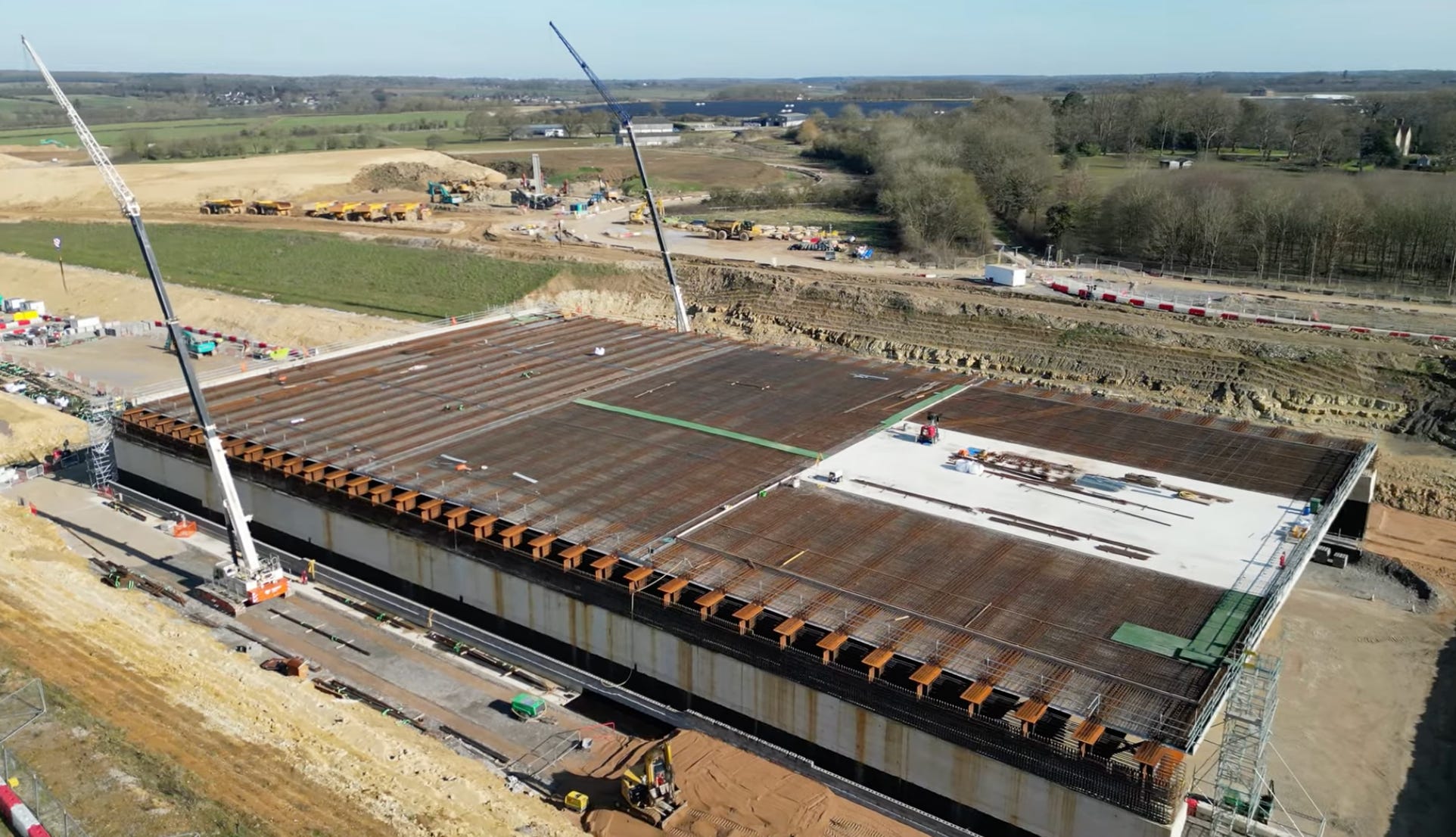
I mean that literally. The Turweston Green Bridge is a structure that you will almost certainly never have heard of1, but which is one of the minor engineering marvels that scatter the HS2 route. 18m high; spanning a 52m gap; and an amazing 99m wide, its official photographs don’t do it justice. Here’s one of mine – to give you an idea of scale, the little orange dots I’ve ringed are people.
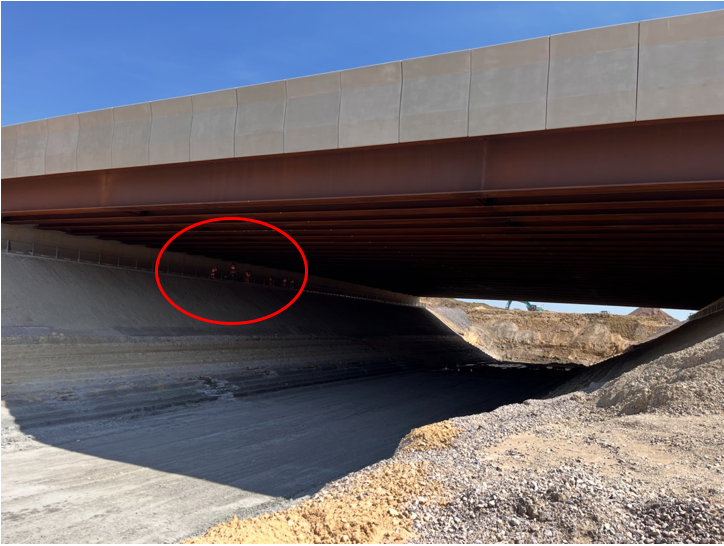
It’s a hugely impressive structure. Three times the width of a motorway, designed to hold a landscape in the sky for a century at least, while the railway zooms underneath at 250mph. Seen in person it gives that sense of how tiny each one of us is, but how when we work together and apply our minds we share the strength of giants.
But it also poses a question. Why on earth is it there?
This is not a bridge from anything to anything. On one side, Turweston is a village of 211 people. On the other side is are two old houses and an airfield popular with the Silverstone crowd. A friend who lives locally says it’s a nice spot for a run. But not something you would spend tens of millions2 building a bridge to preserve.
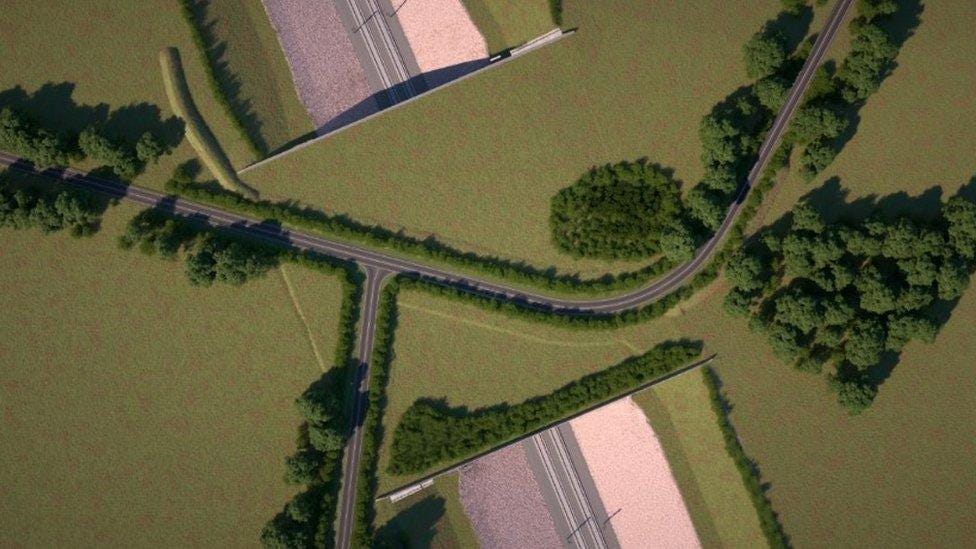
And this is no mere green bridge. If you want to see standard practice, take a look at this one recently finished over the A3 near Wisley to connect two high-value bits of heathland. That is about 10m wide, and cost £3.7m. Turweston is nearly ten times wider, rests on 1.8km of steel girders, and carries 2,700 m3 of earth.
There is one thing it doesn’t have though: any protected species or environmental sites to justify its existence. According to HS2’s typology this is a ‘type 4’ green bridge – one which has nothing to do with bats, landscapes, habitats or wildlife. The official definition of this category is gloriously opaque:
Type 4 – Other types of green bridge with site-specific functionality.
This brings to mind Borges’ Celestial Emporium of Benevolent Knowledge - a fictional encyclopedia where one volume records ‘items included in this classification’. And as far as you dig, you won’t get much more clarity from official documents - not least because this bridge is the only type 4 bridge that there is.
The real explanation might have had something to do with one of the 211 inhabitants of Turweston, who happened to be a close relation of a back-in-the-day-significant cabinet minister. And as I tried to work out how to unpack this story, I wondered if the way to tell it was as another version of the bat tunnel – a crazy piece of infrastructure built at huge expense because of (in this case) political arm-twisting.
A no-bat tunnel
But the more I thought, the more I thought this framing just goes for the cheap click, and misses something much more important. And to explain why I have to return to the story of the bat tunnel.
When we talk about the bat tunnel, there’s an assumption on the part of many people that it is something that shouldn’t have happened - £120m worth of concrete to protect a small colony of Bechstein’s bats. And the framing of this as an error makes a kind of sense – even HS2 and Natural England have been trying to blame one another rather than defend the result.
But now let’s add Turweston to the mix. A structure that is a) as absurd as the bat tunnel but also b) absolutely nothing to do with nature protection. Or indeed any obligations at all. There is no manual we can blame; no policy that can be shown to have forced the matter. It just happened – and happened with the same results as the infamous bat tunnel – as an answer to a totally different problem. So why do we end up in the same place?
The path of least resistance
The question I started asked myself was this: what if these results aren’t an error? What if, instead, this repeated tendency to over-engineer is actually the solution to failings elsewhere in the system?
Every infrastructure project involves choices. Where does a railway go? How fast? Where will it stop? What is it capable of doing? Which drawbacks can be mitigated and how? Making these choices involves processes, decisions and ultimately lead to the physical piece of infrastructure you can kick with a boot.
You can handle these choices in lot of different ways, using different approaches. In the case of the Turweston green bridge, you could take the risk that your senior colleague will flounce out of the cabinet and declare their opposition to HS2. But the option they went with instead was to build a great big bridge to reduce the local environmental impacts and mitigate the impact on the local community.
If you look at the development of HS2, you see that happening a lot. Infamously, the process of choosing a route through the Chilterns turned into a process of choosing a route underneath them, as no amount of digging was more offputting than the idea of facing down angry locals. It was easier to build a £120m bat tunnel than to have a fight with Natural England about how much bat protection is too much.
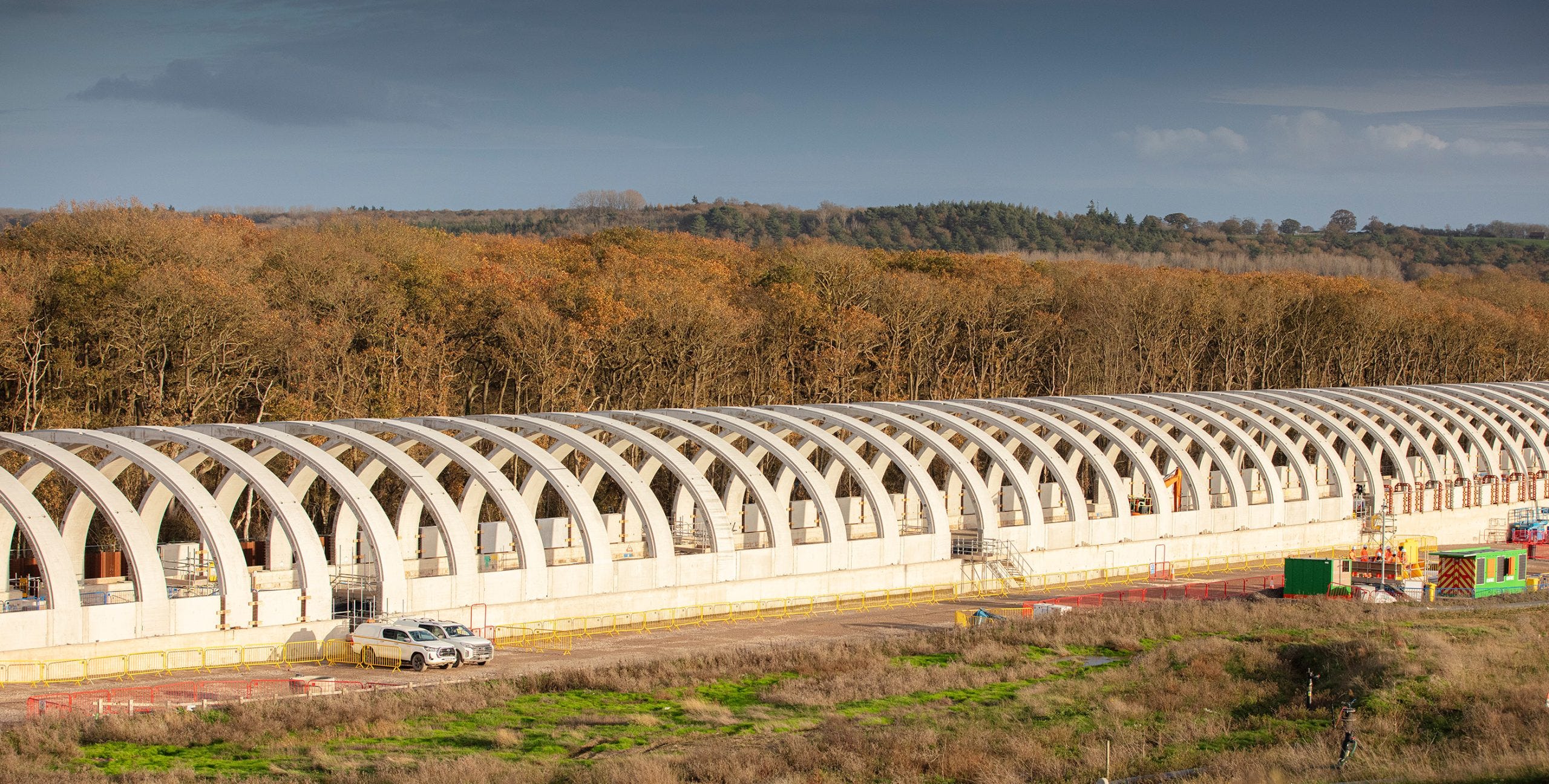
It’s hardly original to say that HS2 would have cost less if the designers had been more willing to push back against all these asks. But as I turn over Turweston Green Bridge in my mind, I find myself seeing the same question from a new angle.
If we see this as a matter of choices between different pathways, the preference for heavy engineering and big structures isn’t just about building things – it’s about building things instead of doing something harder, and following the pathway of least resistance. It is not just that those conversations are hard; it is that the engineering is easy.
In the shadow of engineering
‘Easy’ is a bit of a loaded word here. ‘Powerful’ might be a more respectful way of putting it; but I think it lacks the sense that, as far as policymakers are concerned, handing a problem to the engineers is remarkably close to solving it.
Engineering is a science of solutions; in the rest of the policy world problems are a source of status and power. Put the two next to each other, and the engineers’ ability to answer problems appears close to magical.
A policy fight over bat protection could take years, achieve little, and have answers undone in a moment. But for an engineer, once the parameters are established you proceed to find what sorts of solutions can work. In this case, if you erect 500 concrete rings, string them together with mesh, and make sure the bats can’t fly in, the problem is solved.
This isn’t to say engineering is without its quirks. The Turweston Green Bridge is an excellent example of this. Engineers were content to see the bridge go from 10m to 99m, provided someone would pay the bills. But they were adamant that it could not be 100m – because if it was it would no longer be a bridge but a tunnel. And tunnels come with a whole host of extra requirements, which they would not accept.
But most of the time, building something gets you from a problem to a solution when policy officials like me would only have been going around in circles.
Problems of success
Of course, today’s solution frequently have tomorrow’s problems nestled inside of them. In the case of HS2, all that extra engineering to solve issues that eluded the policymakers (local buy in; design requirements; cabinet politics; regulatory escalation) ended up as a pile of expensive new bits of construction. And, when the bill was totted up, the calculator caught fire. The result of this is that we won’t be having two thirds of the railway that was originally planned, and should count ourselves lucky if it gets into central London.
Other categories of infrastructure have similar problems. Nuclear power is full of uncertainties, which have resulted in the nuclear regulator constantly adding more and more requirements onto new projects – even for well-known reactor types and where the radiation exposure avoided is about the same as that from eating a banana. Each worry is fixed with another bit of engineering. As a result, we are building the most expensive nuclear power station in the history of the world.
Economists talk of a phenomenon known as the Jevons paradox: the more efficiently we can use something, the more we end up using it overall.3 Here, we have an answer to complex questions that is often much more effective than other pathways. So we shouldn’t be surprised to see it used more and more. And that’s a problem if the ultimate result is to make the underlying projects so engineering-heavy that they become totally unaffordable.
The path of most assistance
All of this makes much more intuitive sense when you’re standing on the embankment of what will be HS2, staring up at a bridge so huge it seems to have got lost from the set of Star Wars, and realising that this exists to answer to a minor bit of personnel management in a long-departed government.
Fifty years ago we got structures like this because the engineers went a bit mad; nowadays we get them because the engineers are saving the policymakers, the strategists, the regulators, the stakeholder managers and the politicians from problems that they can’t solve for themselves.4
It doesn’t need to be this way. If civil engineers have become the inadvertent solvers of infrastructure’s difficult questions, policymakers need to start solutionising as well. Civil engineers have centuries of knowledge to help them, but policy officials govern so many intangibles that the engineers treat as unalterable. Let’s imagine a world where policy officials get as solution-minded as their engineering counterparts. I’ll call it the Path of Most Assistance.
That involves a change in mindset: but imagine a nature regulator that tries to balance impacts on one project with bigger gains elsewhere. Or a nuclear safety regulator that sees its job as making safe nuclear happen, rather than debating whether nuclear should be there in the first place. Experts start thinking like problem solvers, not people who know which page of the policy document to follow.
That may sound far-fetched, but it’s a reasonable description of how infrastructure used to work in the UK. Indeed, in nuclear energy, this was the kind of regime that gave the UK such a head-start that it had produced two thirds of all the civil nuclear power in the world by the late 60s.
We have the Turweston Green Bridge because the civil engineers had a ready answer to a complex problem. The way to win our infrastructure back is to create the policy engineers who can provide answers that come without the same price tag.
PS – my great thanks to the team hosting me at section C23. I don’t know if getting all philosophical like this repays or betrays their hospitality; but the one thing I am very sure of is that they have taken the failings of the rest of the system and done their best to fix it. None of the team there made this problem or picked this answer, but they are possibly the only people with nothing to be ashamed of in the wider tangle.
I hadn’t
No cost estimate for the bridge is publicly available, but from what I saw £25-100m looked like a plausible range
Jevons originally developed this idea in Victorian times, as he tried to work out what would happen to Britain after its coal ran out. His crucial insight was that using coal more efficiently would not head off the day when the fuel ran out - if anything it would speed it up
And occasionally made for themselves too
You see this all the time on major capital projects in the UK.
Engineers are trained to solve problems, to deliver solutions. Those in charge, the Project Managers (all of whom were once Project Engineers), have the added burden of having to meet deadlines and, to try at least, to stick to budgets. It is worth remembering at this point that schedule overruns also inevitably increase costs since you continue to burn overheads hence the priority given to deadlines; budget overruns are also less tangible and thus not as embarrassing .
When faced with issues like the ones mentioned in this article ie. those that involve external ‘stakeholders’ and come loaded with uncertainty over what decisions or choices will be made (and indeed sometimes whether a decision or choice will be made at all) is it any surprise that Project Managers opt for the solution that gives them some control and certainty and so get their teams to engineer an answer, that whilst it might be totally OTT meets any and all objections.
Of course the project legal advisors, the planning team, the HSE team (dealing with regulatory permitting and consents) and all those external ‘stakeholders’ are not generally accountable for deadlines or budgets or indeed delivery of anything other than sometimes being tasked with ensuring they ‘minimise or prevent harms’ (a catch all definition that taken to its logical limit means don’t approve anything in case it causes harm). In fact it’s worse as many of the external ‘stakeholders’ have as their raison d’etre stopping the development and most of these groups are rewarded with more work if consultations are extended and continually revisited and decisions postponed (put more crudely they are stakeholders whose stake is primarily in delay or cancellation).
The net result is that as a nation we now struggle to build anything even if it provides a benefit to society and the economy, improves health or safety or is better for the environment, oh and and what we do build is horrendously expensive (and so we do less and less of it).
It’s not all bad however, our policymakers, politicians, institutions, consultants, lawyers and QUANGOs are great at one thing and that is boasting at how wonderful our approach to planning and regulation is. Ironically they often point to our illustrious engineering past to justify this.
Increasingly of course this is becoming more and more difficult and we are being exposed for the charlatans we truly are.
In general we do need green bridges like this and I disagree with this argument that there are no protected species nearby therefore it's unnecessary.
The biggest wildlife problem schemes like HS2 isn't from the land directly destroyed for the railway, but habitat fragmentation preventing wildlife being able to move throughout the countryside. Without green bridges, every infrastructure project is carving the countryside into smaller and smaller pockets some species cannot easily move between. Effectively locking in our current nature depletion, making recovery of it more difficult.
I'd argue more green bridges are exactly what we need, and they should be standard at intervals, and could actually save money if used rather than lots of reactive mitigation measures. And they should be installed over some of our existing road and rail network too.