A Red Herring
How to avert a tragedy

I had plans for the May bank holiday, and they didn’t involve fish.
Twitter had other ideas. For most of the long weekend, I watched YIMBYs and the chair of Natural England sparring about fish protection at Hinkley Point C. The centre of which was a Telegraph article claiming Natural England wouldn’t let the plant start operating until huge new saltmarshes, deeply unwanted by locals, were in place. And, as this could take 8 years to complete, that could mean up to four years’ delay on the plant opening.
My shed stayed unpainted as I tried to reconstruct what was behind this. Because the deeper I went, the more I realised this wasn’t a story about fish.
Be prepared for a most depressing happy ending.
Fish lives matter
Let’s start with the basics. Hinkley Point C is Britain’s first nuclear plant since the 1990s, and has turned into one of the most expensive in the world. One of the most contentious points is a £700m system that has been installed to stop fish getting sucked into the plant’s water intake pipe; of which £50m is for a system known as an acoustic fish deterrent – an AFD in planning documents and a ‘fish disco’ in the newspapers.
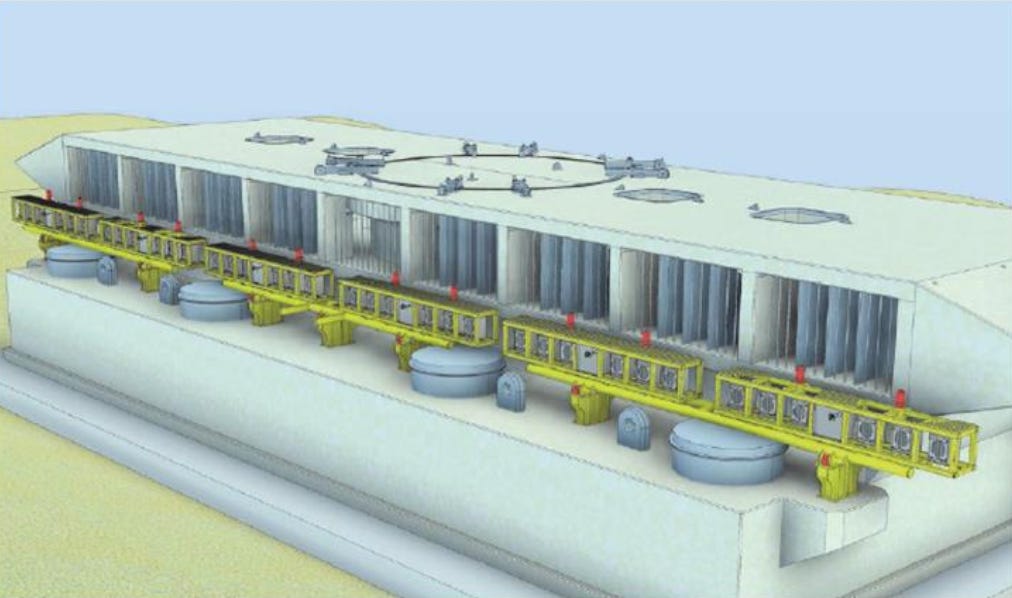
The public debate has largely been about how many fish can reasonably be killed during the operation of the power plant. The ideal answer would obviously be zero, but this is easier said than done when most of these fish are microscopically small. And there is a reasonable debate about how much difference the £700m package makes, especially considering no other power station in the world has such a system.1 That is especially true for the £50m AFD.
But the law requires all possible steps to be taken to prevent harm to protected species, and Natural England and its sea-based counterpart the Marine Management Organisation exists to enforce that law. If it takes £700m of kit to do that, then the project would need to get £700m more expensive. The whole system was included in the development consent order for the plant, with the instruction that the cooling system for the plant could not be switched on unless the system was in place.
All lives matter
So how did we get from here to government-mandated flooding of 900 acres (about 1.3 square miles) of countryside?
Most of the debate on the AFD has been about whether it saves enough fish to justify the cost. But that’s a red herring here.2 The issue isn’t dead fish; it’s dead people.
‘Acoustic fish deterrent’ sounds very high tech, but it’s basically a set of 288 underwater loudspeakers, placed underneath the water intakes to play sounds that will scare the fish away. The technology is already used in the fishing and underwater construction industries to keep dolphins, seals and so on at a distance. But those use-cases are temporary, or see the equipment hauled to the surface on a regular basis - meaning maintenance isn’t an issue.
At Hinkley Point C, they have to be permanent – which means maintenance needs to be done underwater. And because the tidal range of the Bristol Channel is about 10m, the intakes have to be a long way out to sea in order to get a constant water supply. There was no system in the world that had been built for that particular set of circumstances. And in hindsight, they really should have paused on that point. Instead, in 2013 the authorities assumed it was going to be a solvable problem and stuck the AFD into the mandatory planning obligations, meaning it had to be in place for the plant to become operational.
In 2016, the engineers from EDF came back with bad news. It turned out that designing an AFD for this particular location was much, much harder than they had thought, and that maintenance in particular was going to be near-impossible. You had to wire these speakers to heavy duty power systems, which could only be maintained by divers. Those divers would need to work 72 days a year to maintain everything – and there weren’t 72 days’ worth of suitable conditions. Even if they could, they would need to work with near zero visibility, next to operating intakes, with only 30-60 minute windows in which they could work.
Diving is dangerous: not everyone who goes down comes back up. EDF has tolerated a lot in the construction of Hinkley Point C – hence the price tag – but this was the one planning condition that they were firm they could no longer satisfy. This was too dangerous, and they could not do it.3

Fields don’t matter
Saying ‘we don’t want to kill our workers’ isn’t enough of an excuse in the planning system, so in order to make up for the loss of the deterrent, EDF had to come up with a mitigation plan.
If you were wondering why people are arguing about flooding 900 acres of farmland, this is why. This is what the rulebook for these situations expects: what damage you can’t avoid you must mitigate if at all possible. If you are now sucking more fish into your intakes than originally planned, you must make it up elsewhere. Creating new saltmarsh habitats for the fish gives them more space to breed, and helps bring the numbers back up. So EDF began looking for land it could compulsorily purchase and inundate.
Flooding 1.3 square miles of the local area went down about as well as could be expected – even the local Wildlife Trust was furious.4 But this is what would be required to avoid the twin threats to fish and human life. And, with this much clean power and investment capital at stake, no one was going to take the risk of not doing anything.
The unhappiest happy ending
The lines of the debate seemed set. Position one: environmental regulators requiring the absolute minimum disruption to fish; position two: a power company that said it couldn’t in all conscience install a system that would kill people; position three: locals who couldn’t understand why the system was determined to drown their land.
But then, in 2025, there was a twist. Someone invented a better fish disco.
Specifically, one that used ultrasound, reducing the power requirements to a level that works from battery power. That means it the speakers don’t need wires and can be picked up by underwater robots rather than divers. No more risk of death.
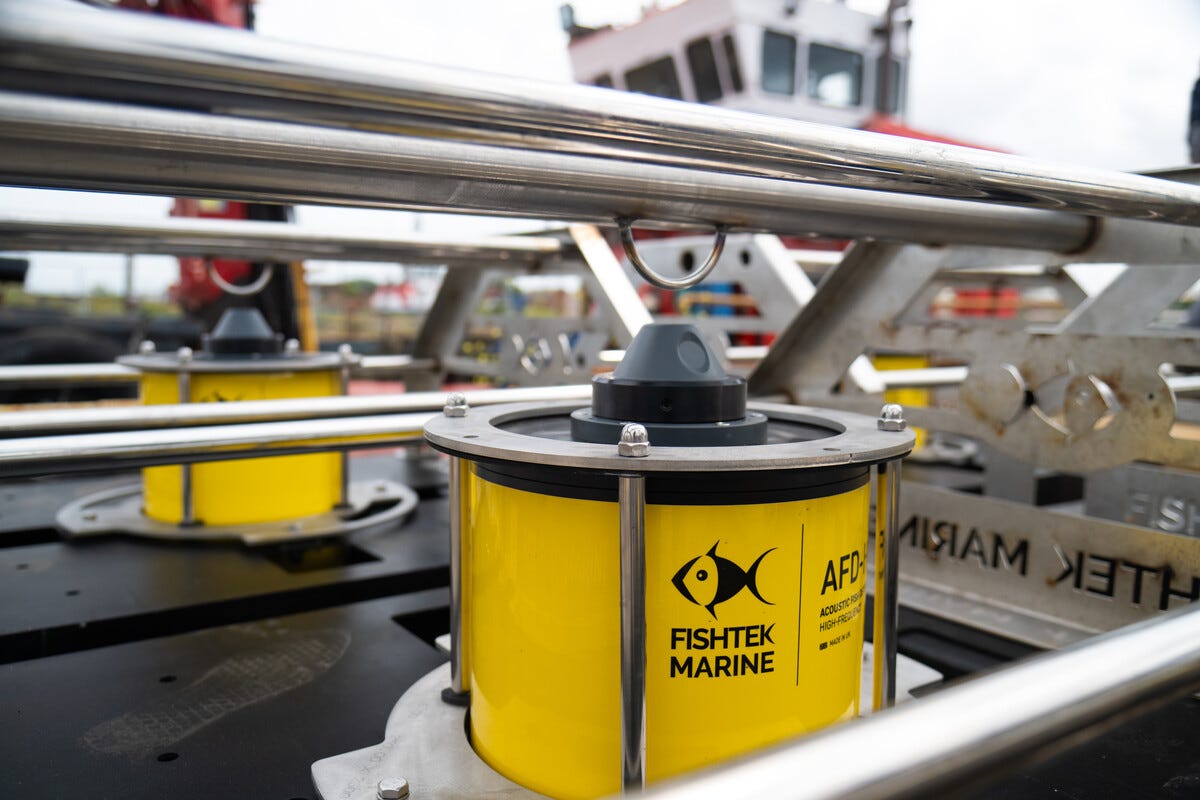
And EDF was delighted. When it became clear that this was a possibility, EDF rushed out a programme to prototype and tested it at the site. They even invited the Chair of Natural England to come down and tag some of the fish for the monitoring, and he happily obliged. When the results came back showing it was fully effective, EDF unveiled the new system to the press. They said they’d now be happy to bring back the deterrent, and that the saltmarsh plans could be scrapped.
What a triumph! There was only one small problem.
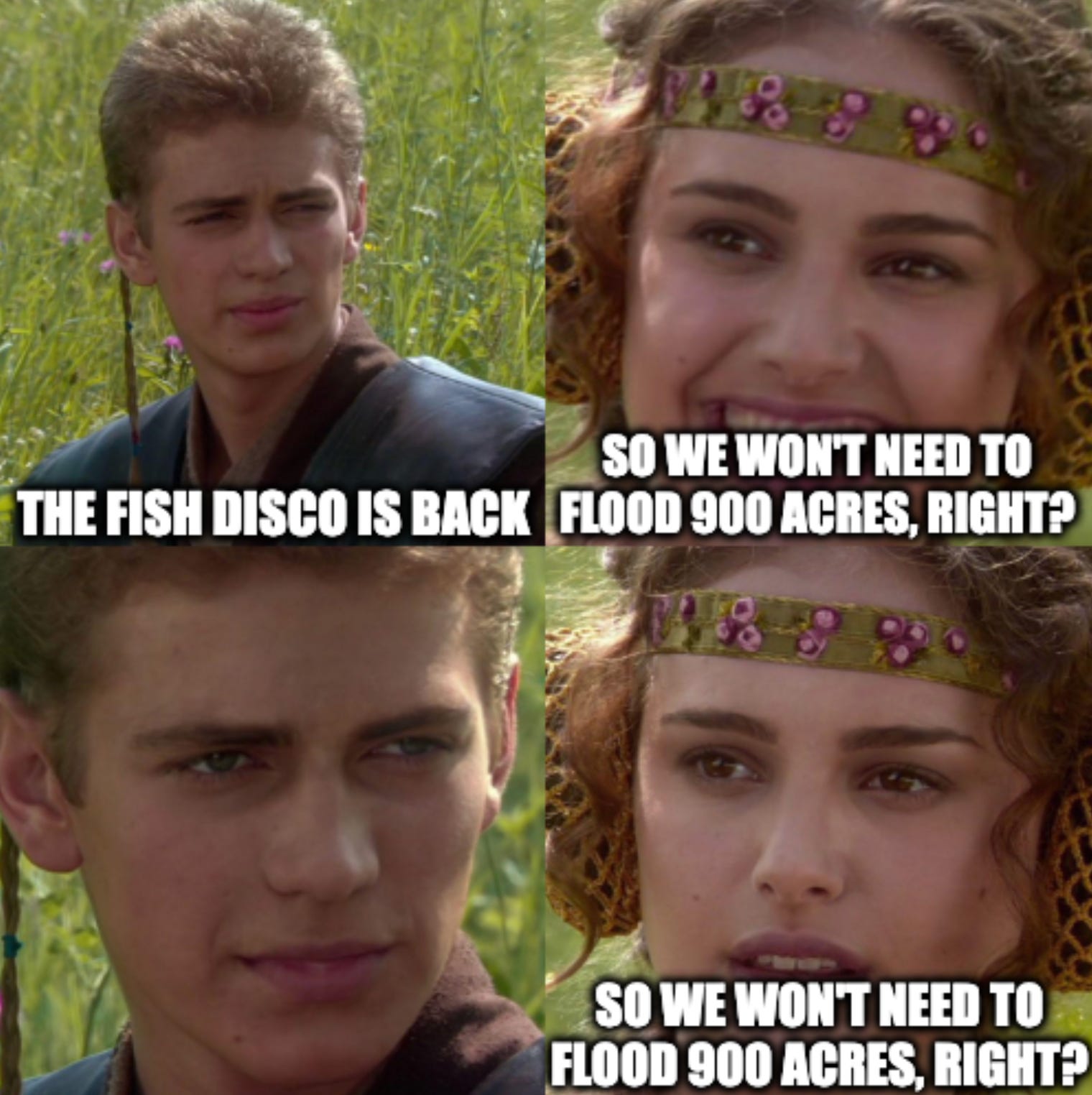
The new system has to be signed off by the environmental authorities. And the new system should be signed off, with a mixture of relief and jubilation. But, according to the Telegraph’s story, someone in Natural England didn’t get the memo. Because they’re quoted as saying that the ultrasound’s effect on scaring away some of the fish species has yet to be proven. And until it is proven to work for every type of protected fish, EDF still needs to flood all that land.
The Salmon of Doubt
This is hardly the outcome you’d choose. If we’d known this kind of deterrent was possible in 2013, it would have been the option the planning inspectors required. But invent it ten years into the project’s development, such that it represents a change, and the regulatory system assumes you are up to no good.
This is obviously daft. When an organisation, locked into a big environmental conundrum like this, researches ground-breaking new technology to provide a way out, it should be a cause for celebration.
I reckon that Natural England’s senior management understand this all too well.5 It’s no coincidence that the Chair of Natural England was helping with the fish tagging in person – he clearly wants to be seen to help resolve this problem. But frustratingly, thanks to the way the story has been reported, his organisation looks obstinate and uncaring. Natural England has the double problem as well that it can’t actually approve the AFD: the final decision belongs to the Marine Management Organisation, who actually sign off the new AFD as working.6
The management put out a rapid blog to set out their position when the Telegraph story landed, with the recurring theme that they really did want to support this project, that they were very impressed by the AFD data so far, and they were only doing what the law obliged them to do. And, for what it’s worth, I think this was sincere.7
But I also think that there’s something they can’t say, but know in their hearts: that the law is making them do things that are extremely hard to defend. We would expect Natural England to be jubilant that the fish disco is going ahead; instead, it is hardwired to demand that 900 acres are flooded until 100% of its demands are met. Once again, the thing that is protecting all the wonders of nature is a system as narrow-minded and relentless as the paperclip AI.
Add to that a culture under which every concession secured must be held and never surrendered. I have now read a fair number of Natural England documents, where they profess to be compelled to act by the law and the science. But if that means setting policy about what ‘must’ be done in such a way that it puts distant workers at risk of death or floods hundreds of acres from afar, I would suggest something more than law and science is needed.
At the bank holiday weekend, there should have been no fight.8 At this point, every serious person wants to see the plant up and running. EDF and the environmentalists have agreed that the fish disco will happen. The only thing standing in the way of exhausted agreement are the badly-designed laws that force Natural England to take indefensible positions, and rob them of the instinct to soften their stance when common sense demands it.
Personally, I wouldn’t shout at the leaders of Natural England for this; because all they will say is the law gives them no choice. But I’d cut the strings above their hands, and tell them they can’t say they are puppets any more. Because if we want a durable system for protecting nature, we need to see humans in charge.
For context, Hinkley Point C is next door to two older plants (A and B) which ran from 1965 to 2022 with no equivalent system, and no obvious environmental crisis as a result. Balanced against that, the Severn Estuary has a lot of environmental protection in place, even by UK standards; and this reflects its importance to a lot of fish species.
A lot of the twitter debate has been about how many fish will die. This is very relevant for whether an AFD is a good idea, but doesn’t drive this debate, so I don’t want to go down that rabbit hole. You can play along at home if you like, as it all revolves around page p51 of this document, which both sides are all ultimately citing. The pro-fish groups cite 1.8-2.6m fish lost per year without an AFD (table 9) - whilst carefully skipping over the bit in the caption saying these are overwhelmingly juvenile fish. And, as these fish species typically lay 100,000 or so eggs at a go, you get a lot of juveniles for each adult: so this is a bit like counting tadpoles and declaring them as frogs. The total number of adult protected fish affected (table 10) are 1-2/week for the most prevalent species, 1-2/month for the less common ones.
The temptation is, of course, to say ‘well they would say that, wouldn’t they’. But, as we’ll see, EDF would prove absolutely delighted to switch away from this option at the first viable opportunity
It doesn’t help that people living in the Somerset Levels are particularly sensitive to the idea of the sea advancing after terrible floods in 2014
And, by extension, the mid-level official responsible for this situation has now had a session of feedback-without-coffee
Though, if you think Natural England don’t have a veto in practice, I’ve got a bridge to sell you
Albeit a little disingenuous in places. Saying ‘our position has not changed since 2013’ may be true, but if since 2013 you’ve found out the plan poses an unacceptable risk of death, your position perhaps should have changed
Though I am very glad I had an excuse not to paint the shed