A twist on the Thames
Captain Hindsight has a valuable lesson for us

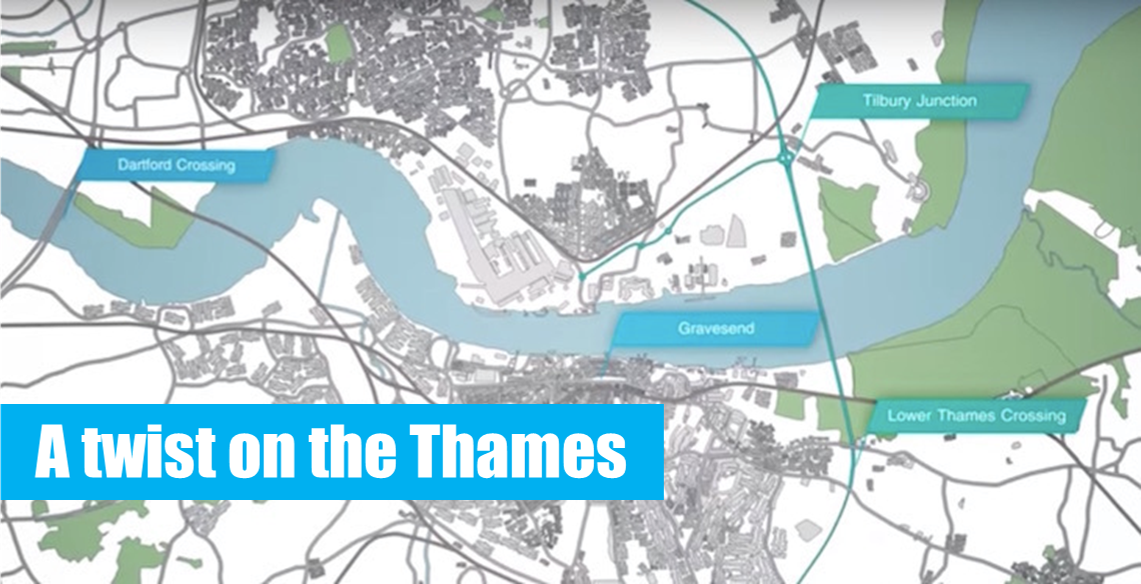
We YIMBYs have our favourite stories. The bat tunnel; the fish disco; and the tunnel that has spent a quarter of a billion on planning applications without breaking ground. What if I told you that the last of these – the application for the Lower Thames Crossing – never needed to happen in the first place?
To be clear – this is not something my old colleagues on the roads programme1 could have seen in advance. But government has made a quiet announcement about the future of the Crossing which has inadvertently put us in a position where the whole messy and ridiculously expensive process could have been avoided altogether…
Accountants and wizards
The convention in England2 is that major river crossings have tolls on them. There’s a history behind this that can wait for another day – for now, focus on the fact that a river crossing with a dependable income stream is a very useful thing to many people. If you’re a traveller, you can use the crossing. If you’re a government, it grows the economy. And – importantly – if you’re a pension fund or insurer it creates a steady stream of income that you can use to provide steady payouts to your policyholders.
That means a clever government official can summon a bridge for free: by getting private investors to pay the costs and repay them from the toll revenue. Better still, international accounting rules mean that, provided at least half the costs are paid by users, it doesn’t sit on government’s balance sheet.
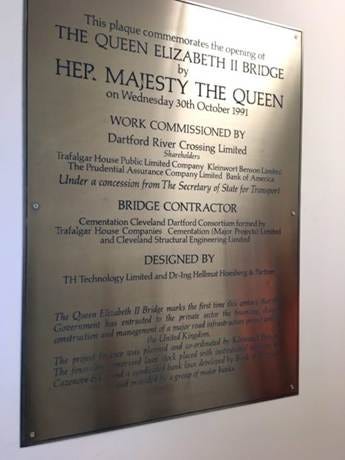
And in the 1980s they cracked how to do it.3 The Queen Elizabeth II Bridge (the bridge part of the Dartford Crossing) was the first to attempt this, and it was a huge success. It got the green light to build in 1988, it was open by 1991, and it was paid off in full by 2003.4 One of the reasons it was so cheap was because it was an early example of a modern large-scale cable-stayed bridge; and the reason this technique was used was because the private consortium handled the design and took the risk on a new approach. The result was the first bridge across the eastern Thames since Tower Bridge, and it cost £120m.5
A tunnel too far
Unsurprisingly, government has wanted the same deal every major crossing since.6 From the outset the assumption for the Lower Thames Crossing was that we’d do the same trick – get the tunnel to pay for itself. And, if the bridge next door could repay its costs in 12 years, you’d be mad not to.
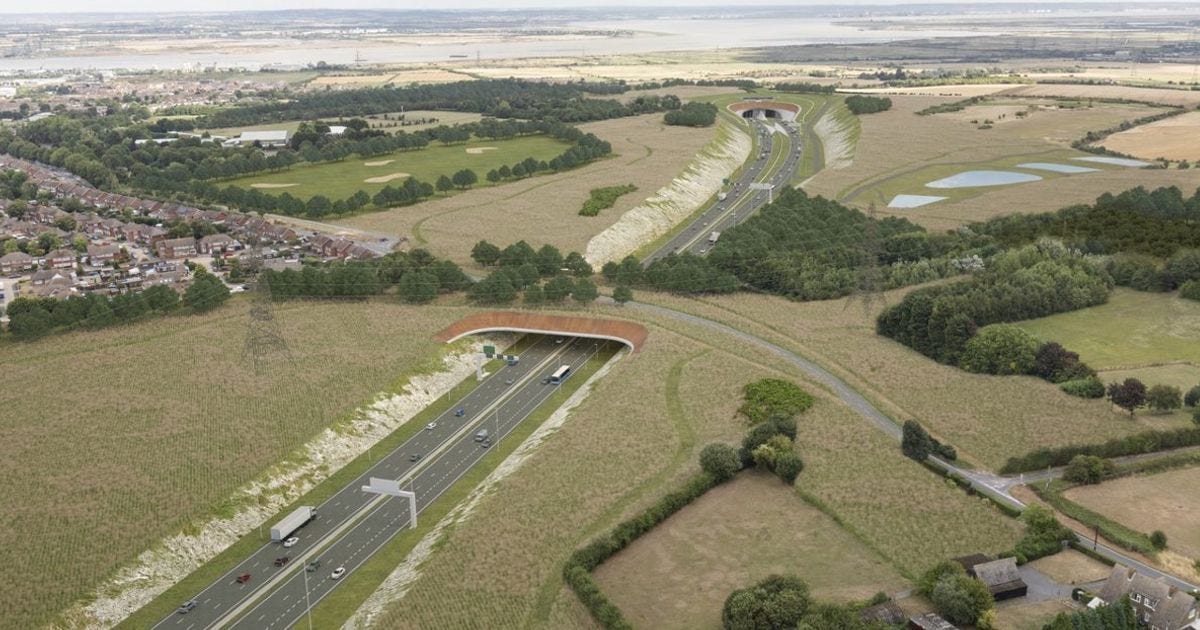
Small problem: since the late 80s the price of construction has gone up by quite a lot more than the willingness of people to pay tolls. And the Lower Thames Crossing is not a small project – more than 20 miles of road with eight lanes under the Thames itself, and a lot bigger than that bridge. Indeed, while the QE2 used clever techniques to cut the costs, LTC is locked into a fairly expensive engineering technique because rules around protected environmental sites meant the team assumed it had to be a tunnel.7
I mentioned that this approach relied in part on a set of international accounting rules. As long as half the project can be paid for by its users, it doesn’t appear on government’s books. As far as Treasury is concerned, it’s mostly free money – and they’re usually willing to make up the difference if necessary. But once you’re over the 50% line, suddenly government’s most powerful ministry realises just how much they’re on the hook for spending.
And then a really bad cycle kicks in. Treasury tells the project team to get it back the right side of the line. The team goes away and finds savings. But in the meantime cost inflation has pushed the price up even more. The projected toll income hasn’t kept pace. So the Treasury demands more savings. It’s easy for a project to get into a doom loop.
Plus, the bigger it is the less tolerant the big lenders will be. It’s easy to invest in something that will pay itself off in a decade or two; but as costs have risen the attraction to private investors becomes less and less. Which means government has to keep offering a better deal.
The Lower Thames Crossing has been in this place for a while. In February it was made official, when the DfT Permanent Secretary had to write a formal note to justify the policy as value for money. Before then there are some obvious tells: the biggest being when all the surface roads - £3bn worth - were split out from the tunnel project and paid for directly by government to keep the tunnel element under the 50% test.
But it seems even this isn’t enough – because now we’re going to play the big card.
Off we go to Parliament
There is one trick that you could do to make the project more commercially valuable. Up until now, every major road crossing has been a concession. That means that the toll operator controls the road for a defined period of time or until a given amount of revenue is recovered, then hands it back to government. But if you let someone own the road forever, that’s worth more.
So last year DfT let it be known that it was looking at a different model for the LTC: a Regulated Asset Base (RAB) model. This is how gas, water, electricity, etc is owned – so not necessarily shocking, but not something used in roads before. That would mean whoever builds the Lower Thames Crossing will own it permanently (together with the existing Dartford Crossing, which is to be transferred with it).
That will get you more revenue, but it gives you one rather obvious problem. You’re about to hand over the busiest road in the UK, on which millions of people rely. And whoever owns that road is going to want to change the prices at some point. Trouble is, they’ve got something close to a monopoly power, and can set the price a lot higher than what it currently is. If you want to know how badly this can go, take a look at ferry prices to get a car onto the Isle of Wight, which can now be £300/trip at peak holiday season.
But you can’t just say government will set the prices. If you’re a business looking to invest billions in order to get returns over decades, you can’t leave your farebox to the whim of ministers either. Without greater surety, you can’t invest; and the Crossing never gets built in the first place.
Before you panic, this is a problem with a well-established answer – appoint a neutral party to set a ‘reasonable’ price. And in gas, water, electricity and so on that job is done by independent regulators like OFWAT, OFGEM and so on.
However we have a problem for roads – because the Office of Rail and Road doesn’t do that job. It doesn’t have the relevant legal powers. And I would know, because in 2014/15 I wrote the legislation that got them into the roads business.
So if you’re going to need to change the powers of the ORR, that absolutely requires new legislation. Which has one extremely ironic consequence…
Crossing the same stream twice
This isn’t the first time a crossing of the Thames here has required legislation. Because the QE2 bridge – that ultra-successful PFI – also had its own act of Parliament.
That Act covered off how the bridge was to be paid for. But at the same time it also gave the bridge full planning permission. Because Parliament can do that.
So that £279m-and-counting, 400,000 page, 10-year struggle to get a planning application through? It turns out we could just have written it into a government bill, and skipped most of the process. This is how many words it takes:
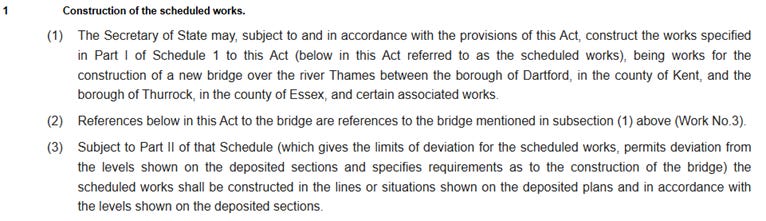
And that’s … quite a lot less than a quarter of a billion pounds worth of work.8
So the most notorious example of UK planning bloat turns out to have been completely unnecessary.
Captain Hindsight to the Rescue
It’s too late for this to be a useful insight: one of the government’s biggest planning achievements was actually granting planning permission to the Lower Thames Crossing in 2025. It’s more one of those realisations that send all good civil servants mad towards the end.
You may well take away the thought that we should be using Parliament to fix these problems a little more often. A few people are chasing the same thought right now: the Centre for British Progress and Labour Together did a good paper on doing this at Heathrow for example. I want to write more about this in the future, as there’s a lost story about how we tried to speed up planning in the 80s and early 90s that centres on this method – but that’s for another day.
But there is a more direct lesson worth taking from Lower Thames Crossing: that we don’t take the challenges of construction seriously. There’s a parallel version of the story of the Crossing, when people sat down just before serious development started in the early 2010s, and recognised they were about to start the most expensive road project in the history of the country. They looked hard at the path ahead, and asked up front for the tools that could deliver maximum progress at minimum risk. In that world, we’d have had the legislation in place by the mid/late-2010s, construction underway before 2020, and you’d be driving on it by now.9
Instead, people saw this as another piece of engineering, and once the policy decision to do it was reached all the policy officials went on to more interesting questions. They left the project team to build this thing by themselves; just like we left HS2 and many others to get on with doing … whatever it is non-policy people do.
We’ve never been short of opinions to give to project teams. But we seldom give them access to the full toolkit the state has at its disposal. If we do, we never give them the leadership to use those tools to maximum effect. There’s a tragedy about the contrast between the sophistication of the engineering techniques being deployed in a project like this, and the policy officials like me turning up as whimsical amateurs to guide it through its greatest trials.
As it stands, the lesson officials will be taking is ‘dream smaller’. Which is never the right answer.
Full disclosure - the Lower Thames Crossing is one of the few roads projects I didn’t have a hand in shaping
And historically Scotland, until the SNP abolished all bridge tolls in the 2000s
Not to discount a lot of historic projects that worked on this basis during the Victorian era and before
One old teammate of mine joined the civil service at that time and his first job was replacing the toll with a congestion charge so government could keep charging people for going over. How his faith in the system survived this is a bit of a mystery, but I was very glad it did.
About £300m in today’s money. And yes, before you ask, that will be less than the planning & procurement costs for the Lower Thames Crossing
PFI has come in for a lot of stick over the years. I’d really stress - the kind of deal that came about on the QE2 bridge is win-win-win. People get a bridge/tunnel that they find useful (or they wouldn’t pay to use it). Government got someone to make them a cheaper bridge than they could make themselves, and didn’t have to find the money or trade off against other spending. Taxpayers who don’t use the bridge don’t pay anything. And big investors - especially pension funds - love the asset they get. Provided the contract is competently written, this is an absolute free lunch for all concerned. Although the LTC … doesn’t exactly measure up to that standard.
Whether right or wrong, this is explicitly and solely because of environmental impacts. See para 5.4.87 of this: TR010032-005958-National Highways - Other- 7.2 Planning Statement_v2.0_clean.pdf
I’d note in passing that there are now environmental charities pushing for environmental listing of the land underneath the QE2 bridge because of its ecological value, so this might have been a premature conclusion.
An environmental assessment is still required, and you still need to actually design the crossing. We should be talking low tens of millions for that
Getting ahead of inflation also means it would have been c.20-30% cheaper
I notice the Act of Parliament is for a "new bridge over the river", does that mean the tunnel is consider just as "associated works". Why not call it a crossing?
Thanks for the article, so clearly explained.
god this is depressing