Making Britain Build Again

It seems Britain can’t build. Not houses or hospitals or roads or trains or pylons or reactors or reservoirs or runways or data centres or film studios or factories.
But how on earth did we get here?
Oddly, not a lot of people have asked that. So I and some colleagues tried to piece the story together. You can read out full report online here. Do read it – we had fun, and it shows.
But here’s the quick version
First off – we don’t build slowly because we’re bad at physically building things. Construction projects can go wrong (looking at you, HS2), but that’s not what makes it take a decade to widen a roundabout.
Instead, there’s a huge forest of procedure to get through before anyone is allowed to start construction. The first thread I put up, back in the distant past, was an attempt to explain why that was so onerous.
There are a lot of chunky bits of process you must discharge: you need to look at lots of different options before you start; you need to carry out big surveys (esp environmental ones). You need to consult and engage the public, more than once. You need to pass a planning inquiry.

And you need to not get sued in the process. The fear of which means that all of those tasks have silently expanded as the years went by. Ten years ago the biggest road project in England had a 270 page planning report. Recently, a new slip road in Essex had one at 220 pages.
But that’s only half the story. How did we get here at all? I’m going to argue, counterintuitively, that the reason we’re so bad at building things in the UK is that we got too good at it.
Our planning system was created in 1947. And for most of recent memory the UK had been in a building frenzy. Partly that was WW2 – the Air Ministry built 9,000 miles of runway in six years. That’s four times the length of our motorway network. But also a massive prewar housing boom
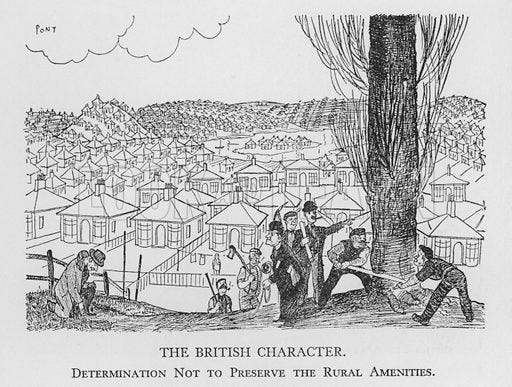
And Britain had a deep history of caring about nature. Everything from Wordsworth to Sunday rambling to the National Trust. Even a monster like me feels his heart lift at the words “England’s green and pleasant land”. This is not the global norm.
In 1947, that drove a reaction against urban sprawl, in a new system that controlled development and protected cherished land. But it was directed by governments that still sought to build at wartime scale and pace. So the 50s saw massive delivery of infrastructure.
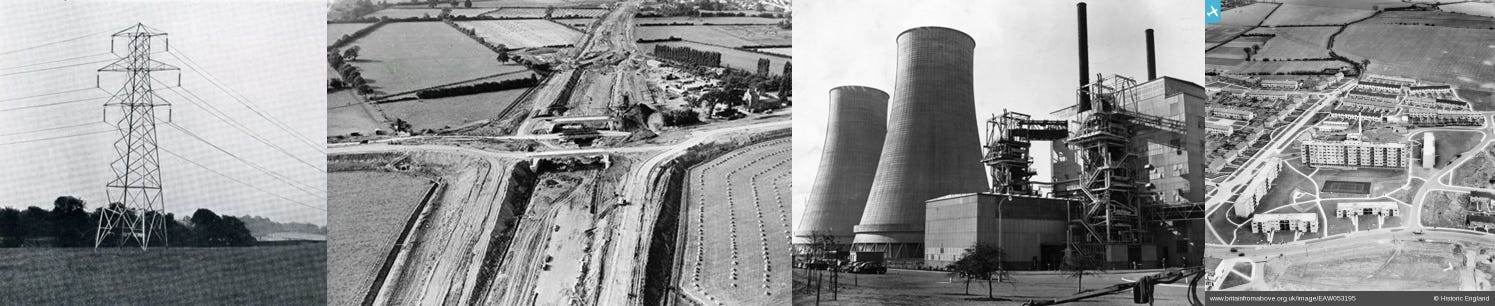
But by the sixties, it began to unravel. Much of that 50s infrastructure was controversial. And there was a lot of unease about how towns and cities were being redeveloped and losing their charm. So government decided to increase public participation
‘If we talk more, there will be more consensus’ is a running theme in the world of infrastructure. I don’t think it really worked out. In the 50s, public inquiries took days – even (in one case) for a nuclear power plant in a national park. By the 80s, they took years.
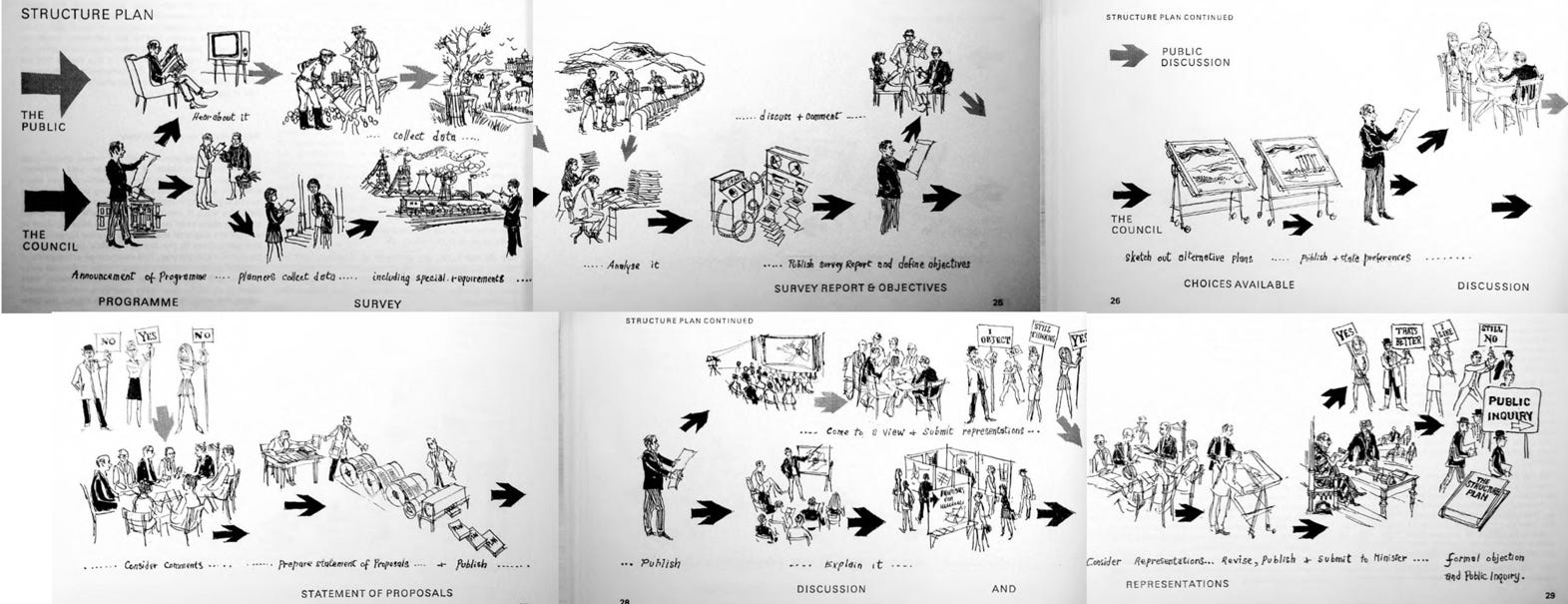
(In hindsight, it might have been a warning that the committee set to work out an approach to greater consultation came up with a plan so lengthy that the diagram ran across six pages)
And they became much more contested – especially in the case of London’s urban motorways. Even more remarkably, from the 1970s the opponents started winning. So fighting became very worthwhile.
The planning system had also created a platform for a much more sophisticated system of environmental protection. It began in the 50s with protections for migratory birds; urban heritage became more important in the 60s. From the 70s the list grew. By the present day, we also have to handle a huge increase in environmental understanding, which is hardwired to turn into automatic protection through the planning system.
And other things made it worse. Costs grew and money became scarce. European law replaced broad processes with tightly defined procedures. But at its root, the problem was this – the planning system was caring about many more things, and still hoping to find an amicable consensus.
Reservoirs illustrate how badly the system crashed. In the 60s we built 2-3 a year. Then this change came over the system.
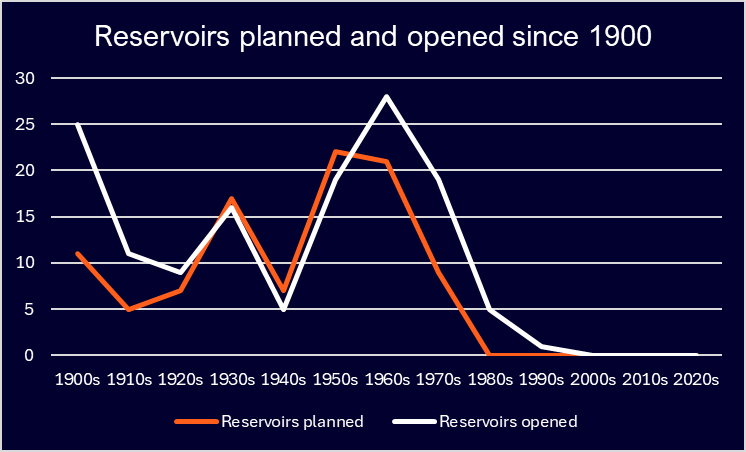
No one in the UK has got planning permission for a new reservoir since 1976. Presumably it’s quite hard to find a consensus about drowning a village.
People have tried to reform the system. Success is mixed. The Planning Act 2008 did away with those multi-year public inquiries. But accidentally replaced them with even longer periods of pre-inquiry investigation.
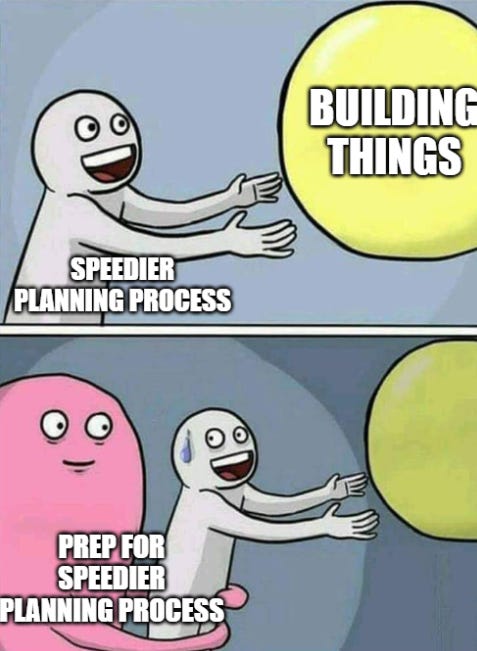
And we end up with absurdly slow developments. The poster child is the Lower Thames Crossing, which has spent >10 years and more than a quarter of a billion pounds on planning documentation and process. But the real crime is on the everyday stuff, which people can reasonably expect as part of the housekeeping of life. Enough pylons to keep the lights on; the unjamming of a roundabout; a school hall that doesn’t fall on your child’s head. All of that is what a failed planning system confronts us with, and it has consequences.
Government has just laid out some helpful streamlining of that process. Smarter processes for managing environmental impacts (no more bat tunnels!) and a more organised process for consulting affected people and orgs.
But I think that there’s a deeper truth driving this.
Many people think that the lead time for developments is unreasonably long. Even 51% of Green Party voters we surveyed thought that environmental regulation should be cut to speed delivery of some projects.
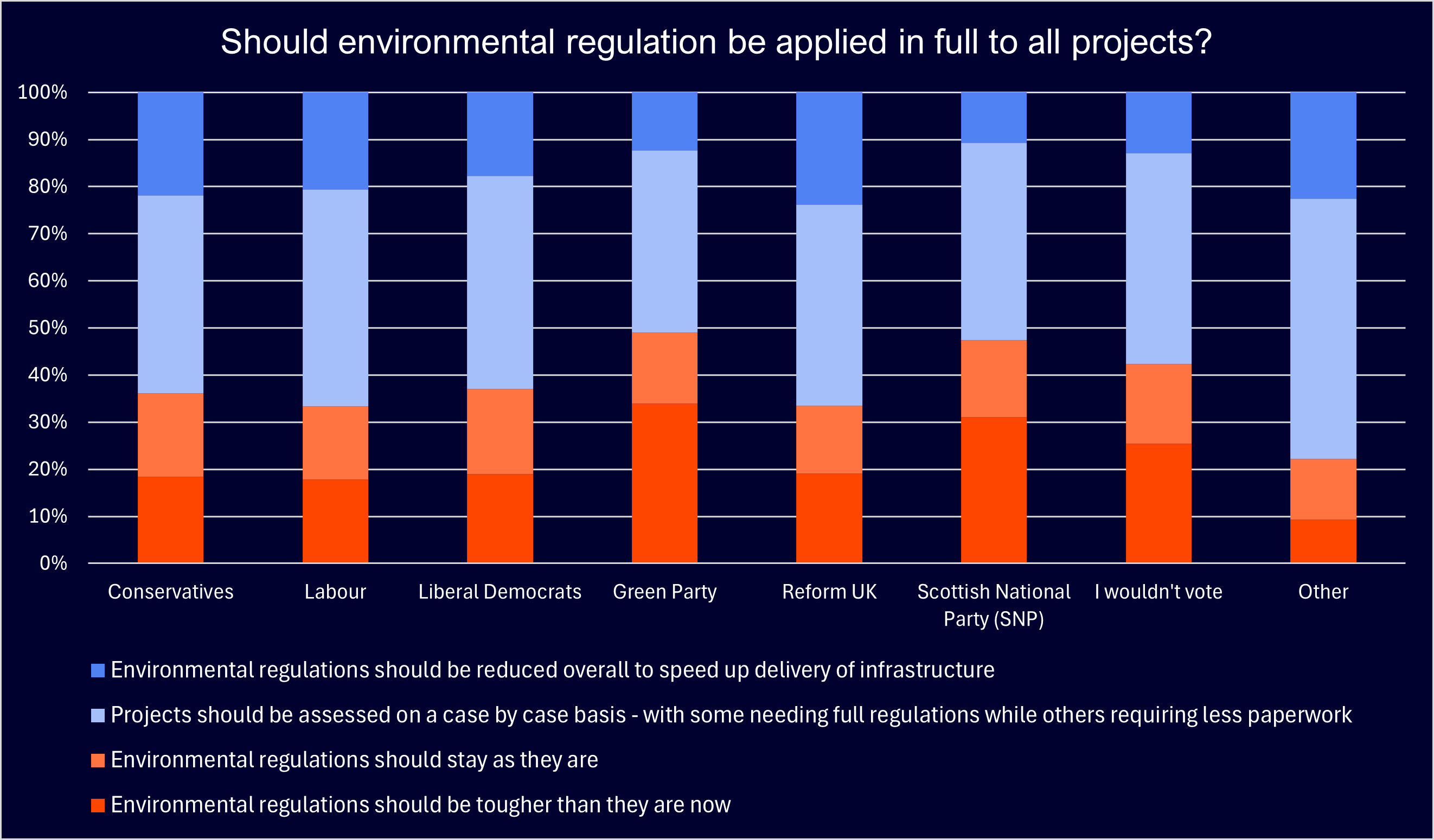
But drill down, and that unreasonable time is made up of reasonable asks. Few of us would stand up and say we didn’t want to see e.g. endangered species considered, or flood risk ignored. Those questions aren’t a bug of the system – they’re definitely a feature.

But they add up to a process where a government can’t get a spade in the ground during the five-year life of a parliament.
Doing the right thing all the time, in exhaustive detail, has broken the system. And it’s very challenging to propose doing anything less than what’s ‘right’.
Now, in practice, there are much smarter ways to do what’s right. The government’s new Nature Recovery Fund is a good example of that.
But real reform – the kind that can solve this problem – demands we confront the piecemeal way in which we stacked up all these good intentions. Our idea is that you recentre the process on time. Some things should take time; some things should be swift. Where they’re simple, we can agree to move faster. And we can use that judgment to decide how much detail you expect the builders to consider – and you can cut a 5 year process down to 1.
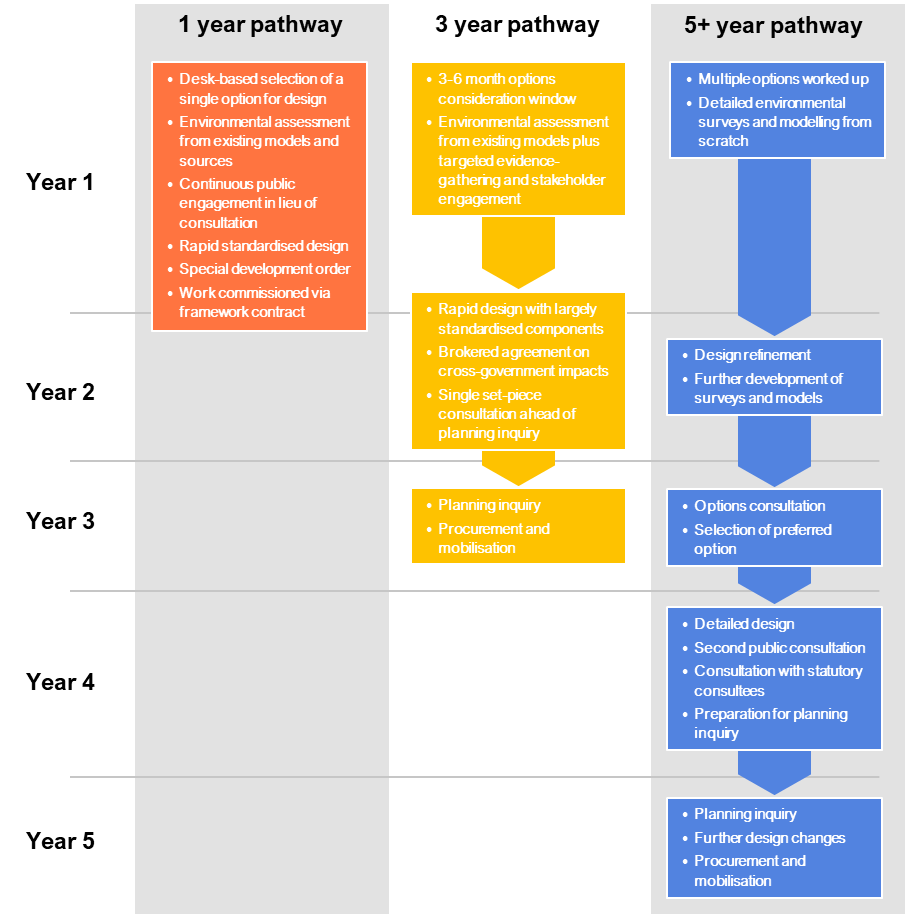
Building hasn’t got harder. Indeed the physical act of building things has got easier.
But the mental load has exploded. Once it was enough to know how to hold up a bridge. Now builders need expert knowledge in more fields than you would for a moon landing.
This isn’t normal, and it isn’t natural. It isn’t how Britain built in the past; and it isn’t how anyone intended we build today.
But we need to change it, if we’re ever going to build our future.