Norse by Northwest
Why I need to build a tunnel under the Pennines

I need to be honest with you – for the past year of this substack, I’ve been hiding a little secret. Perhaps not such a little secret. As of Monday morning, it’s out. Very out.
About a year ago I created a company called Future Works. We’ve been operating under the radar to try to solve a mystery, and revive an old project. Back in my DfT days, one of my teams was working on a project to connect Manchester and Sheffield. TLDR: we’re bringing it back, using a set of engineering techniques that seem able to radically cut the costs. We’re going to build it longer, so it can go under the National Park from side to side. And we’re going to bring back the parallel railway at the same time, because it has a massive synergy.
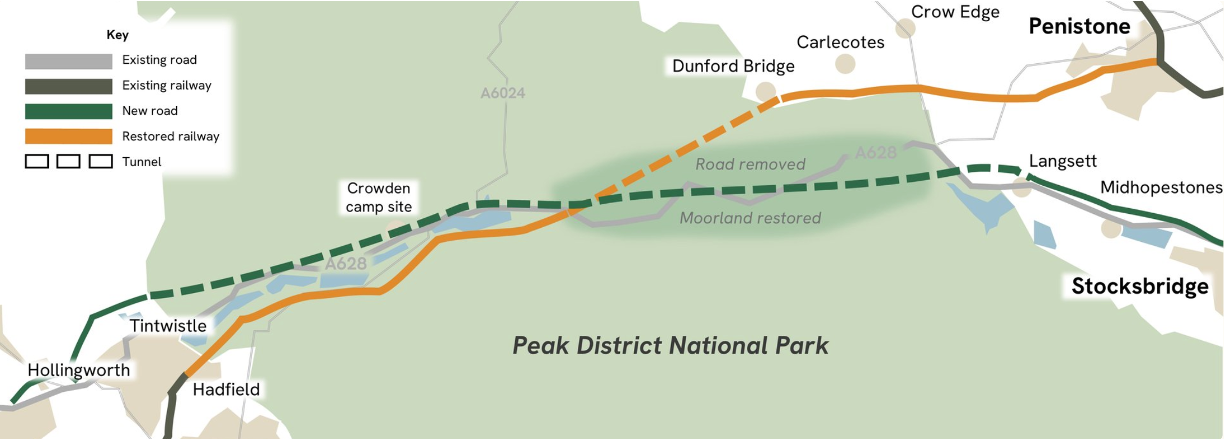
I’ve spent all week outlining the plan. See www.transpennineconnect.com for lots of details. But for this substack, where we’re a little deeper into the philosophy of infrastructure, I’d like to talk about something else. Not why it makes sense to build a tunnel; but why on earth am I and my compadres so mad as to try and make it happen ourselves?
Atonement
Quite a few people have asked me over the week why I’m doing this, on a personal level. I answer ‘guilt’.
From 2015-20, I was the person responsible for creating the next road investment strategy. We were the first people to have five years to write the next plan, and one of the obligations that came with that was that no problem was too big for now. We created six ‘strategic studies’ that were meant to do at least something to reshape the national map.
I wanted us to have a project on our options list as ambitious as Crossrail, and so we started looking into the Trans-Pennine Tunnel. Links from Manchester to Sheffield are properly terrible. Most big-city pairs have a dual carriageway or motorway link. This pair has two pre-Victorian turnpikes, one of which is infamous for periodically falling down a hill. But in between them is the Peak District National Park, which is not the kind of place you go a-road-building. A tunnel fixes both problems at once, and lets you tear up the surface road and hand the Park back to nature.
Obviously, government didn’t proceed. The benefits were good1; but the cost was just too high.
But deep in the foundations of that decision was a mistake, for which I am at least partly responsible. What I’m doing now is fixing it.
Boring decisions
We’d always assumed that the way we dug the tunnel was a tunnel boring machine (TBM). This is the standard UK approach – basically a 50ft-tall drill that drives its way through the earth using the power of 5-6 skyscrapers. It’s a good method for most of the UK, and when we brought in French tunnelling engineers to be expert consultants on our early trans-Pennine thinking, they didn’t even entertain the idea of another approach. We concluded this was a non-question. All our engineering and modelling work was structured accordingly.
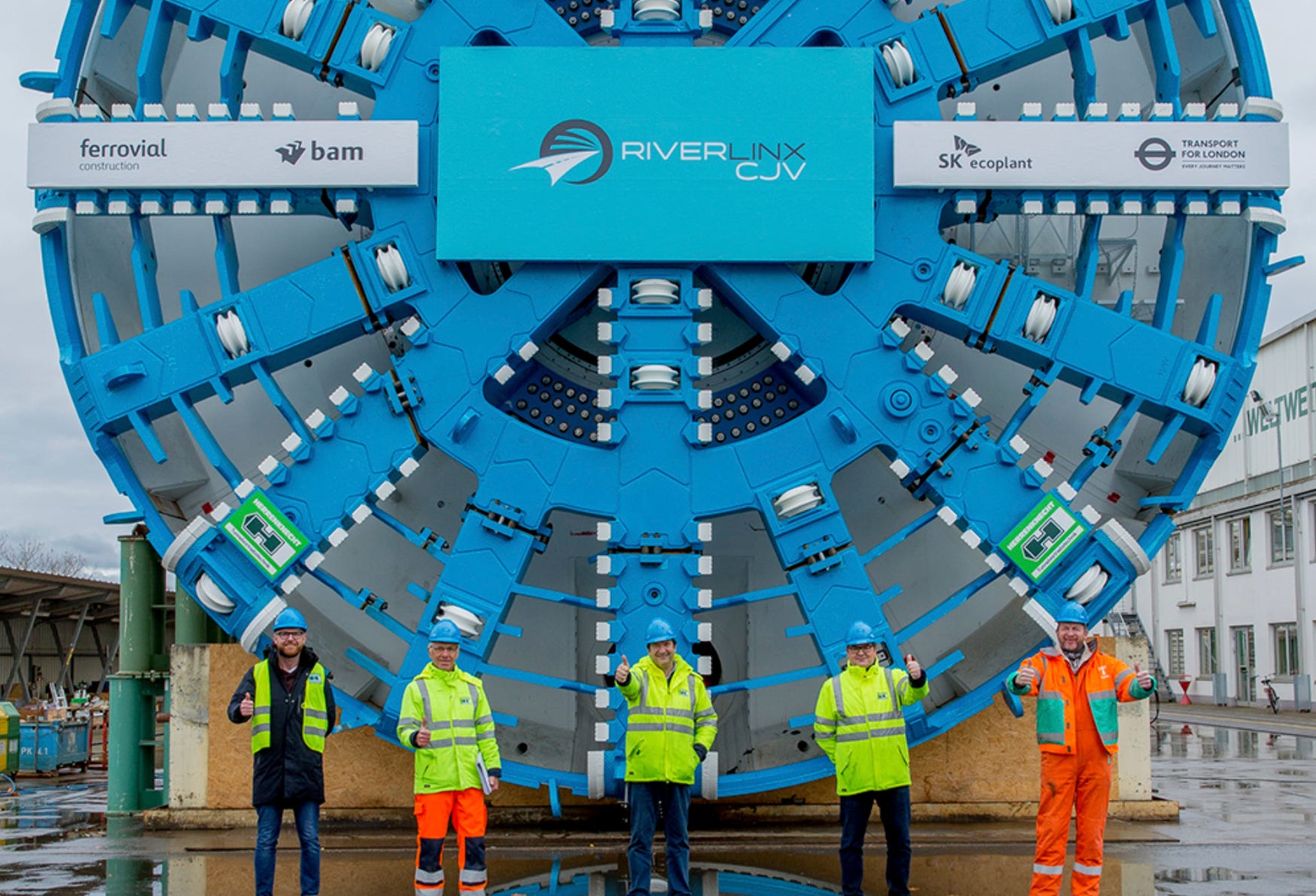
It was maybe 18 months later that I started to see we’d missed something. One criticism of the tunnel plan was that they were unrealistically long2, so I looked for something of equivalent length. I came across Norway, where the Lærdal Tunnel was the longest road tunnel in the world, and therefore a good example to cite. But then one day I idly converted the prices from Norwegian Kroner into UK prices, and did a double take. It had cost under £100m.3
Norwegian tunnelling turned out to be cheap. Extremely cheap. The fact that is most commonly known about Norwegian tunnels is that the Lærdal cost less to build than we have spent on the environmental statement for the Lower Thames Crossing. That’s true. But there’s an even more shocking one.
At the time, we were just finishing upgrading the A14 in Cambridgeshire – a 21-mile long project adding a lane to an important dual carriageway that ended up costing £1.5bn. We were extremely proud of the project, and rated it a massive success. At the same time, the Norwegians were working on a project called the Ryfast. It was a new dual carriageway, similar scale, and cost around half as much per mile. It was also 300 metres under the sea.
And now the divergence is absurd. The M25/A12 junction upgrade adds a (quite complicated) two-lane sliproad to an important M25 junction for £180m. In contrast on the Faroe Islands they were digging two five-mile long tunnels between different islands for £100m and £130m.4 They even threw in the world’s first undersea roundabout.
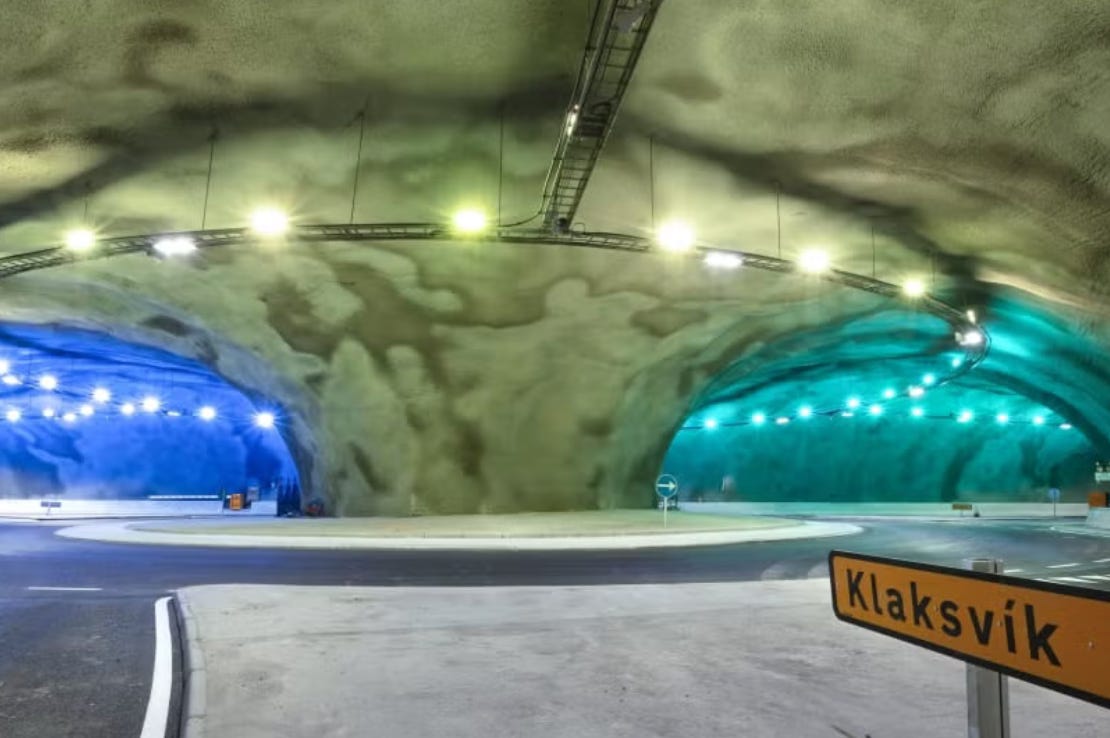
They use these methods to connect islands with 300 people together, and consider this to be common sense. So why were we struggling to use it to connect an area with 50x more inhabitants than the Faroes?
Don’t be boring
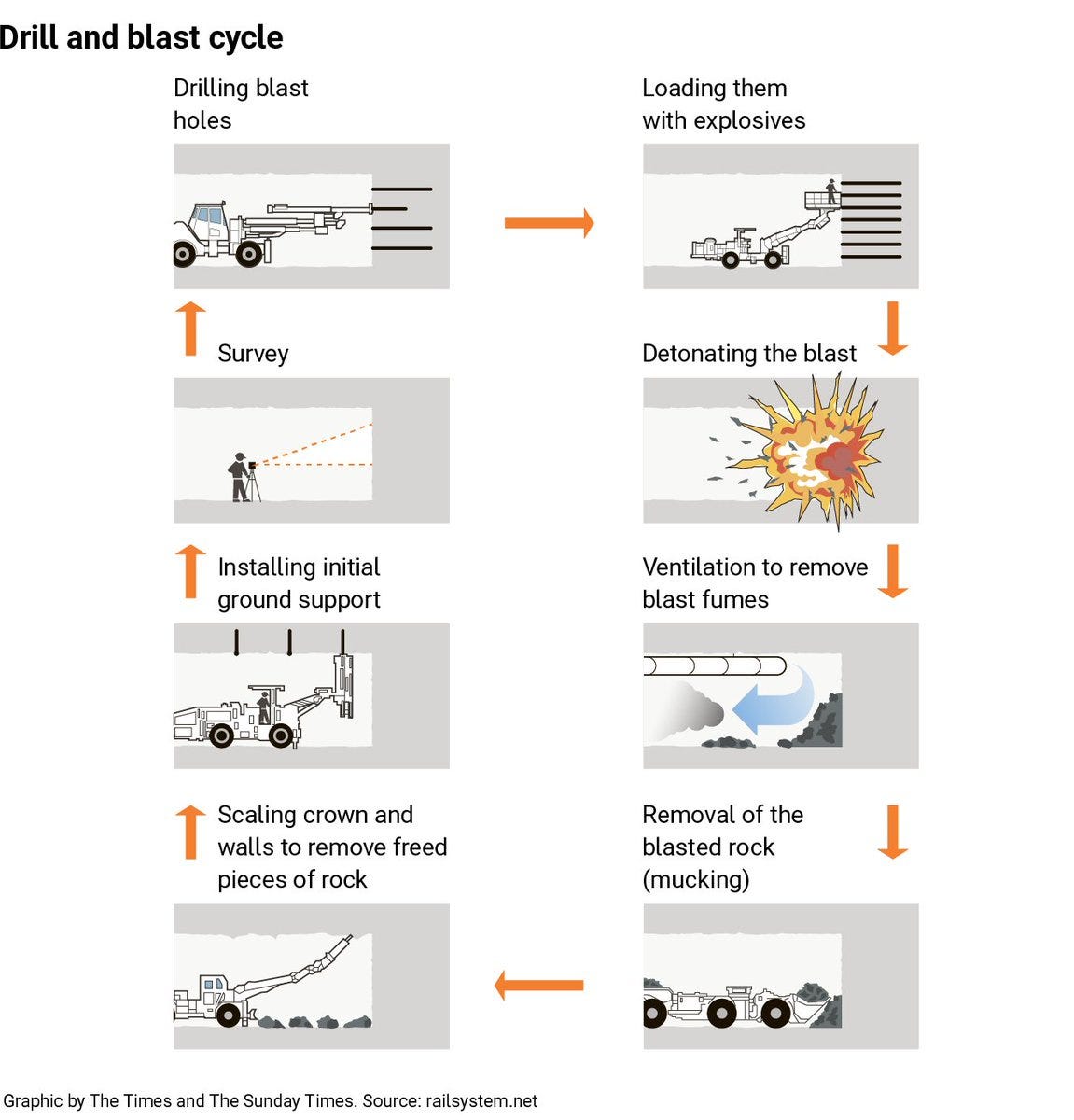
What I now know is that the Norwegians use a different engineering technique: a mixture of drill and blast, together with a wider tunnelling philosophy called the New Austrian Tunnelling Method.
This does away with the big boring machine, and instead uses a team of expert tunnellers who use a mixture of dynamite and construction plant to clear the rock away.
Rather than building a big concrete ring a foot thick to hold up the earth, they use the natural strength of the rock to hold up the roof, aided with steel bolts and a sprayed concrete mix.
This method can’t work in soft ground, ruling out most of the UK. But it can work in hard rock, like the Pennines. And the resulting cost per mile was about 90% less than we were expecting on our project.
You’d imagine that having identified the opportunity, the next steps of the story would go something like this: I would say ‘they make cheap tunnels here, let’s find out more’, we’d investigate, learn, adapt and implement. After all, these tunnels have been built, for prices that we can audit and account for. This is not theory, and facts should quickly resolve any disputes.
What actually happened was that I shared what I knew with my project lead. I asked them to find out more, and they said they would. And they didn’t. Three or four times. What I should have done as the person in charge was to hold them for account to that, but I had other priorities.
I also tried to flag it up with the wider project governance. Deciding to be a little devious, I thought this would work best if it was a challenge from Transport for the North, who notionally co-led the project, rather than me. I teed up the right person, put the information in his hands. And after mentioning it in one meeting, he never returned to the question.
Later, it dawned on me why there was so little interest in taking action. If you are able to find a 10% cost saving in a project, you are everyone’s best friend. But if you find a 90% cost saving, you are everyone’s worst nightmare – because you’ve implied that everyone else is a fool, and the system they are part of is inept.
Back then, I had faith in the system, so I waited patiently for evidence and facts to win out. I did not do what I should have done, which was to shout and yell and make a lot of hullabaloo to insist that we dig into this until we could explain clearly what was impossible about it. Perhaps I would have been quietly told not to fuss – clearly there had to be a reason we weren’t already doing this But at least then I would have tried, and wouldn’t have been as accountable for the consequences.
Instead in 2020 the project went to the big investment board, and came back without a tick. Not a no, because you couldn’t say ‘no’ to a business case like that without giving yourself awkward questions on a bunch of rail projects. But the kind of ‘not yet’ that could easily be read as ‘don’t come back’. A year later, after I’d left roads, the whole thing was shut down.
Redemption
I might have lacked skill; but I have never lacked stubbornness. Four years later, I wasn’t a civil servant any more. And given that this still bothered me, I decided I would lay this question to rest myself. I picked up the phone to a company called Norconsult, who were the consultancy behind many of these tunnels.
It turns out that the answer to the question ‘why don’t we do this like the Norwegians’ was ‘because you didn’t pick up the phone’. After an hour’s conversation, I understood drill and blast; I understood the link with geology; and I understood that their cost-per-mile figures were business-as-usual, not freaks of particular projects. I learned they had exported the technique to Iceland, to the Faroes and to Sweden – where they were building an underground version of the M25 around Stockholm. And as I read more on the history of Norwegian tunnelling afterwards, I learned why they hadn’t used a TBM in decades.
Then I began filling in my own pieces of the puzzle. I could see how the project geology would be on our side. The British Geological Survey confirmed the ground conditions; Norconsult sent me photos of a tunnel under construction right now through comparable rock using their methods.5
And I could take all the other work from the old study, and revise it in light of what I now knew. It was obvious at once that these cost reductions meant we had something vanishingly rare – a megaproject that would be able to pay back its own costs. The UK hasn’t had one of those in a very long time.
There’s a whole separate post to be written about how this rewrites the life story of a major project. The short version is that the development of a major project is wrapped around internal games that government unconsciously chooses to play, and we aren’t obliged to follow that path. This means we avoid things like the forced-rethink of the Leeds Tram, and we capture opportunities (like restoring a rail line to better-manage construction waste) that the state can’t see. And, because I’ve laboured under those rules for too long, that’s immediately visible.
Not to mention that the business case, which looked solid when the cost was in the range of £10bn, looks world-changing when you’ve brought the costs down to Norwegian levels.
Freedom
So – we can build the tunnel now, right? Right?
No. All I have is fate standing there, clapping and laughing at me. You’ve found out that this project has the potential to be great value. Wonderful. You probably should have done it right when you could then, because this project isn’t getting a second chance.
If I had any illusions about that, they were quickly dispelled when I called a few old DfT friends to say what I’d found. It was all very polite, but totally unbelieving: this cannot be true. It is too far from what we know. Offering them photographs of the delivered projects that disagreed did not change any minds. How could an institution as big as a government department miss something as big as this?6
Well, I was in the room when we missed it. I know how many seconds it took.
So if anything was going to happen with this fact, people outside of central government will need to be the ones making it happen. The numbers make it possible; the missing piece is the machine to do the hard yards.
So say hello to Future Works – me, and a few likeminded people, who think this is worth trying. And, over the months ahead, will start assembling the necessary machinery to make this real. In twenty years of infrastructure, I haven’t seen an opportunity like this – either for the people who make it or for the nation as a whole. If you let that pass – twice – you will spend the rest of your life in the shadow of what you never did.
So wish us luck: we’ve got a mountain to move.
Thanks for reading to the end – if you want to hear me unpack more, I should be on YIMBY pod from Monday telling a little bit more; and we’ll be unpacking our ideas more over the summer. We love to do this with friends, so if you’d like us to write for/talk with you, please do get in touch. And if you are a financier who would like to transform the north whilst getting a commercial return, now would be the perfect moment to chat.
BCR of 1.8, since you ask. That’s 4-6x HS2, and also better than the trans-Pennine road upgrade we are building
Admittedly, one of our tunnel options, which went all the way from Manchester to Sheffield, would have been the longest in the world. But we only analysed that so we had an evidence trail to say ‘this is not a good idea’ later.
In 2000 money. About £130m uprated to today’s prices.
It is even possible - though I would like to stress I’ve only done very rough maths on this - that the infamous Calmac ferries in Scotland have ended up costing more than a tunnel for the same route at Faroese prices.
Also costing a tenth as much as a similar-scale UK project
I’m keeping a running list of DfT reasons for scepticism: it doesn’t do long tunnels (it built the longest road tunnel in the world); it doesn’t work where people live (news to the people of Stockholm, who’ve lived with it for several years); the geology’s wrong (did you look at the photo?). They’ve stopped giving me reasons now, and just say it’s unbelievable.
Needed to fly into the Faroes in 2017 as my dad was unexpectedly disembarked from a cruise due to illness. I was expecting to need to take ferries to get between the airport and the main hospital and was absolutely blown away by the roads running around the islands and then constantly diving below the sea. I imagined the cost had been astronomical and funded by an EU infrastructure fund for undeserved citizens. I've still never seen anything like it 10 years later.
Of course this is how the mining industry does... mining. There is a vast amount of expertise available to do this.