The biggest mistake we're making on HS2
...is nothing to do with trains

About a year ago, I wrote an article I dared not publish. It was about accountability for the failure of HS2, and it started with a description of the 18th century admiral John Byng being executed by firing squad. His crime was insufficient zeal in chasing the enemy, resulting in one of the biggest defeats of the war. What, I asked with an unsubtle implication, was accountability for HS2 going to feel like?
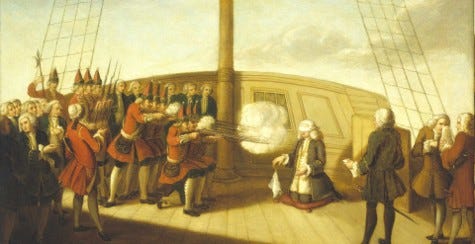
I chickened out: I have many friends who worked on HS2, and on balance I thought they might have felt sad if it looked like I was calling for them to be shot. But the question remains – given HS2 has gone so very wrong, who do we blame and what should we do about it?
And, after Tuesday’s HS2 report launch, I’d say we’re no closer to answering it. We do at least know how much the project costs (£87-102bn), when it will open (2036-9 to West London; 2040-43 for Euston), and how much money we have effectively set on fire (£50bn net welfare loss).1 But what we don’t know is who is to blame. And without wanting to make an extra enemy, I’d say Heidi Alexander’s speech was a sign we’re not going to find out.
It was the other guy
If you put together the new Lovegrove Report with the Stewart Report last year, there’s a message coming out of all the reports and post mortems on HS2 that a key reason things went wrong was political pressure. And in Parliament, Alexander went straight for the Tory jugular.
“If this seems like an obscene increase in time and costs, it is because it is. If it seems that I am angry, it is because I am. I am angry on behalf of taxpayers and affected communities who have been swindled by the failures of successive Conservative Governments”
“To translate: it was a massively over-specced folly, with the prospect of the fastest trains anywhere in the world tickling the fancy of Conservative Ministers.”
“I do question where the shadow Secretary of State, the right hon. Member for Basildon and Billericay (ex-Tory transport minister and shadow Transport Secretary Richard Holden), is today. This is not the first time that he has run scared from an oral statement, and I can only assume that it is because he is embarrassed by his party’s abject record on transport.”
I hold no brief for Tory ex-ministers – I’ve known good ones driven by a passion for public service and bad ones driven around in the biggest ministerial cars they can wheedle. But I think that making this political is a serious misdiagnosis of the problem.
To be clear, there’s no doubt that HS2 was shaped by political pressure. The civil service consensus on the merits of high speed rail was spelled out in the highly-respected 2006 Eddington Report, which could be summarised as ‘whatever you do, don’t build a high speed railway’. In 2009, Labour minister Andrew Adonis announced we should build a high speed railway from London to Birmingham, Manchester, Leeds and maybe beyond.
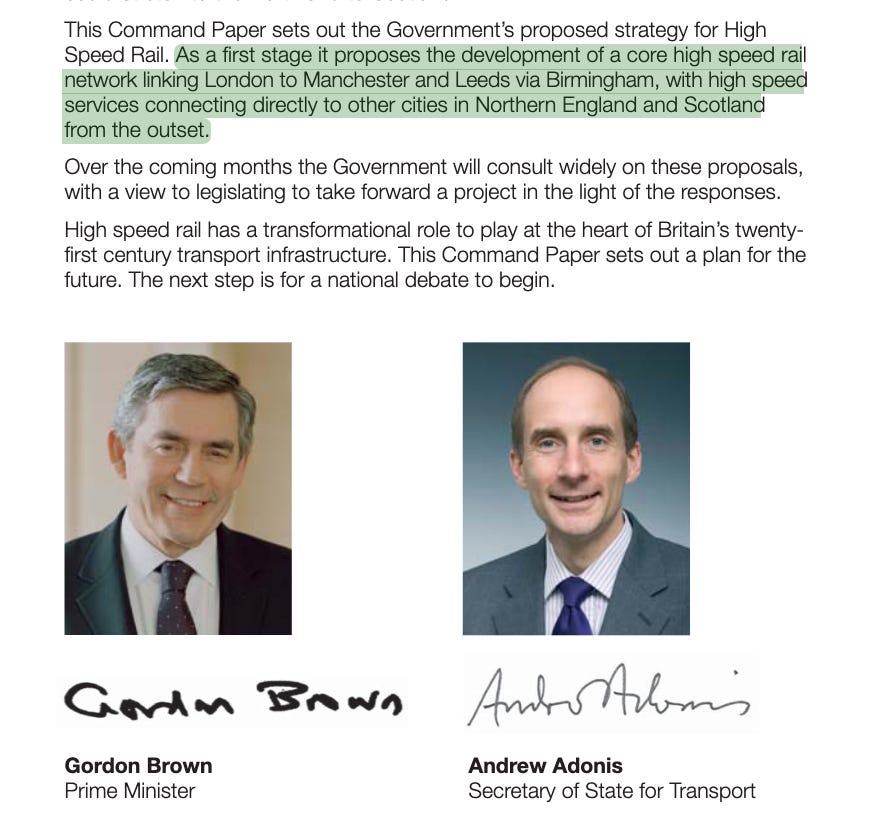
There were a lot of decisions made after this point, under Tory leadership, which don’t look good in hindsight; and many of these had a political element to them. So there is a basis in seeing the problem as anchored in ministerial decisions.2
But in saying that we set up an unspoken implication – if the bad politicians made everything go wrong, everyone else was just an unlucky victim. Thank goodness that the bad people are gone, and only the good people are left.
You can see the attraction of that – for the ministers responsible today; for the civil servants whose career is mid-flight. But it also means we don’t ask ourself the most important questions of all about what went wrong with HS2.
Scapegoat of State
The complaint about the role of politics is that it made certain decisions – particularly the ones that were needed to reduce the costs and scope – impossible to make. For example there’s a consensus that speed made the whole project much costlier3, but you supposedly couldn’t drop the speed because the politicians wouldn’t let you.
It’s certainly true that officials felt there were things they couldn’t do. The trouble is that, if you talk to the politicians, they felt exactly the same way. I remember talking to someone who was very influential in the Department during a crucial design period, when it was becoming clear that achieving the proposed speed was going to require huge amounts of unexpected ground stabilisation. They said that it felt like they had no choice either. You couldn’t be responsible for ‘not-so-high-speed-2’.
So if you really want to chase this back to its source, the real problem is that HS2 was presented to the world as a simple, clear and very coherent vision: a very good train like the kind you get in France or Japan, to link our biggest cities together. Departing from this was a huge risk for everyone - politician or official. I would not describe this as politics; and I wouldn’t really describe it as strategy either – almost one of those Terry Pratchett situations where the story has a life of its own, and is making all the humans dance to its beat.
Original sin
So should we say it’s all the fault of Andrew Adonis for forcing that narrative dance upon us? If you’re going to blame it on politics, maybe; but I would disagree with that too.
In 2009, it wasn’t unreasonable for a politician to propose a new high speed railway. We’d just finished building HS1, which is half the length of HS2 phase 1, and which had been delivered on time and on budget. The vibe in the department (after years of worries about cost and schedule overruns) was that HS1 showed we knew how to build this stuff. Adonis himself has mentioned more than once the inspiration of past major infrastructure programmes like the motorway network, and my read is that he wanted to do something for the railways that would have a similar impact.4 That is the kind of leadership we generally blame politicians for not providing.
As it turns out, Adonis did make a serious mistake. But it wasn’t in thinking there was a case for building a high speed railway5. It was in assuming the DfT could deliver what he asked.
The word no one said
In saying this I need to be clear – I do not accuse the people sent to build HS2 of being personally incompetent. I know a huge number of good people in DfT and HS2 ltd who gave their whole effort to making the project work. These people have been more betrayed than anyone by the course of events.
But I would not be so generous to the system they were part of. It’s essential to remember that HS2 has failed because of more than a decade of great effort on the part of the system it was entrusted to; and in other countries this process works. It could not fail on that scale because of a few bad apples - you need a tree that grows season after season of cursed fruit.
The real question for why HS2 went wrong is why the word ‘stop’ was never said. We now know this is a project where costs were unknown, schedule ungoverned, the delivery board had lost control and where the BCR was 0.3-0.4.6 DfT deployed many tools that are supposed to pick these things up.
But they didn’t. Even when it was their explicit responsibility. One of the quiet evidence drops around this week’s announcement was a set of four Accounting Officer statements around the decision to proceed with HS2 construction. The Permanent Secretary of the Department produces these when they need to confirm that an idea meets the standards expected of public spending, and is an opportunity to challenge ministers where there are doubts about this. Ministers are then entitled to overrule them should the reason to proceed be a political one. Each time the Permanent Secretary’s assessment is the same – we are still within the bounds of acceptable action.7
Or take the infamous benefit cost ratio - the number that DfT bases so much of its thinking around. A decade of hard calculation was put into this, and in these notes there are various assessments that swear the value for money could be justified. I remember in 2010 they went so far as to redefine the value of time in order to boost the numbers. Yet the latest accounting officer summary shows these numbers were so wildly out that you could reasonably call them worse than useless.
Nor is this just a series of errors just before the decision to invest. This is built on top of ten years of work in DfT to set up and manage the arrangements for building HS2, when the Department knew that everything was not plain sailing. Take this paragraph:
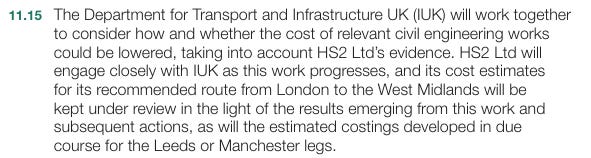
This might sound like the kind of action people would take in 2022 or 2020 when project costs were a source of deep concern. It is actually from 2010, when HS2 was initiated. They were concerned then that the price of high speed rail in the UK was roughly double the European average. The neighbouring paragraph reassures readers that even a 5-10% reduction could save up to £1.5bn. Unfortunately, after a decade and a half of study and action by civil servants, the result has been a 400% cost increase. Had the original report put a figure on that outcome, it could have saved us all a nasty shock.
The problems were known. What is startling is that the methods applied to address it didn’t work; and didn’t really change either.8 There was a constant expectation that one more round of analysis, or one more effort to improve programme management, or one more rewrite of a terms of reference would fix it. And, when a decade of this clearly hadn’t worked, the top people still waved it through.
If this sounds harsh, please remember - this is something I have been complicit in. Some of what I say here is a criticism of a whole class of public service, in which I used to number. My space was highways, but if government infrastructure teams can’t govern these enormous risks properly, you eventually hit the stage where the rest of the world has to ask ‘what is the point of you?’ And, more pointedly, ‘is there any alternative to these people?’
We’re all looking for the person who did this
Does this mean DfT is asking itself searching questions about whether it is fit for purpose? Well, nobody wants that.
The newly published Lovegrove Review was designed to take forward the questions from the Stewart Review that were of particular relevance for HS2 Ltd (the government company set up to build the railway) and at DfT. And its conclusion is that HS2 Ltd really let the civil servants down.
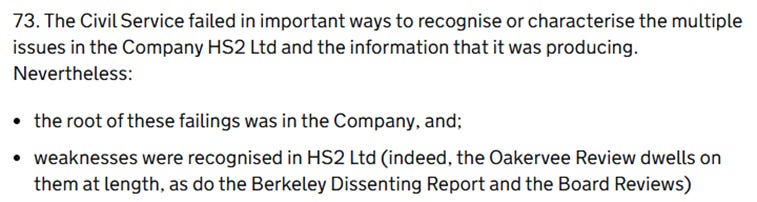
There are recommendations for DfT – they needed more skills, they needed to understand risk. The job of the person responsible for overseeing HS2 within DfT was too big, and couldn’t be done properly.9 But the elephants in the room go unrecognised: why was it that, after a decade of effort and analysis, ministers were advised to push ahead with a broken project on flawed data? Where were the warnings? How had problems been fixed? Who was writing plan B, as opposed to xeroxing plan A and changing the names?
This is a conspiracy of powerlessness: civil servants of different departments agreeing that their job is not to deliver success or warn of imminent failure, but to ensure the highest professional standards of aimless drift.
A once in a generation mistake
In another corner of the civil service, they are talking about revising the Civil Service code – the document that is meant to drive the behaviour of the profession. A frequent criticism of the current one is that it encourages timid, passive behaviour, and there is an appetite all the way up to the new Cabinet Secretary to change that. Re:State published a good paper on this earlier in the month, that suggested new values that civil servants should be expected to display. Ownership; excellence; courage; openness.
I think the HS2 debacle shows civil servants working on infrastructure need some of those missing values. Courage is essential – the simplest error on HS2 was the inability to speak about what everyone already knew. Ownership is the thing that means you fix problems, rather than imagine someone else will be your saviour. Excellence may be a stretch here, but let’s start by expecting that efforts should lead to measurably better results; and if it doesn’t it is openness that will allow those problems to be managed rather than buried.10
This will probably be the last time anyone is invited to ask big questions about what went wrong on HS2. But it shouldn’t be. On a purely practical note, DfT is sponsoring Northern Powerhouse Rail, East West Rail and the Lower Thames Crossing, whose combined value is over £60bn, and none of which has passed the point of no return. These are excellent projects, and they deserve to be known as something better than a national embarrassment.
Either the civil service works out how to support infrastructure, or we’ll see more grand projects fall over in an expensive and avoidable way. We need to get to a place where ministers, setting visions for their departments, can rely on delivery without having to check. There are still a lot of lessons to learn from HS2, and we’ve got powerful reasons to keep studying.
Because the biggest mistake we can make on HS2 is to do the same thing twice.
The solution to this has been to descope the signalling system, remove automatic operation and reduce the top speeds of the train. This is said to save £2.5bn - though it is a little unclear how much of this is real money as opposed to abstract allocations to manage project list. In return, the maximum capacity of the line goes from 16 trains per hour to 12. There aren’t plans to run more than 12 trains just now, so this might make sense; but personally I wouldn’t trade 25% of the capacity and a strike-proof operating system for a 2-3% cost saving.
The project had the backing of all the major parties, so I think you have to see this as a bipartisan consensus.
I would agree that speed was too high, with the important caveat that nearly all the costs that result from that come from the route and construction standard of the line - decisions that were made nearly a decade ago and have already been physically built into the design at tremendous cost. Any entity without a bottomless source of funding would have cut speed in the mid 2010s when the detailed engineering began spelling out the problems.
And it wasn’t just high speed rail. Adonis also set in motion a big programme of electrification, intended to make the UK railway network majority electric. This was not in any way shaped by politics, but it did turn out to be an equal basket case - nearly 20 years on we’re not yet 50% of the way through delivering this, and I would be surprised if the four projects that made up the electrification push were finished before HS2.
I will remain silent on whether it actually is a good idea - I merely note that it is a reasonable ask from an elected politician
In layman’s terms, for every three pounds we spent, we got one pound of public value.
I think Dame Bernadette Kelly, the Permanent Secretary during this crucial period, was lucky to retire last year. Were she still around, I think her position would have been about as tenable as the lady who ran the Post Office during the horizon scandal.
IUK, mentioned in the paragraph above, is the direct ancestor of NISTA, which we are now promised is putting its top people on helping HS2
This last one was a surprise to me, given they gave that person a knighthood in 2023 for services to the railway. Perhaps it was to salute his perseverance in the face of such an impossible task.
There are reasons that this is harder than it looks in the world of infrastructure, but that’s for another day.
Good piece, but only mentioned Bernadette Kelly at end. IMO BK was the villain of the piece. HS2 would never have got off the ground if the 3 review points had remained in place. DfT did not tell parliament/ CPAC in 2016 prior to phase 1 bill that HS2 Ltd had failed review points 1 on costs and control. BK realised that HS2 would never pass review point 1 as costs increasing and MPA report stated that high chance HS2 would cost £80bn. So BK just removed the 3 review points and then Graying & Ghani, just kept telling parliament that HS2 was 'On time & on budget' all the way to the final vote on HS2 phase 2a.
What went wrong with HS2, from the man who got HS1 right:
https://www.newcivilengineer.com/latest/what-hs2-could-have-learned-from-hs1s-30-years-of-success-14-10-2021/