The impossible journey?
Is the UK government really going to make electric vehicles pay per-mile?

So the government has leaked that it plans to charge electric vehicles 3p/mile. 1p/mile for plug in hybrids. Is it going to work?
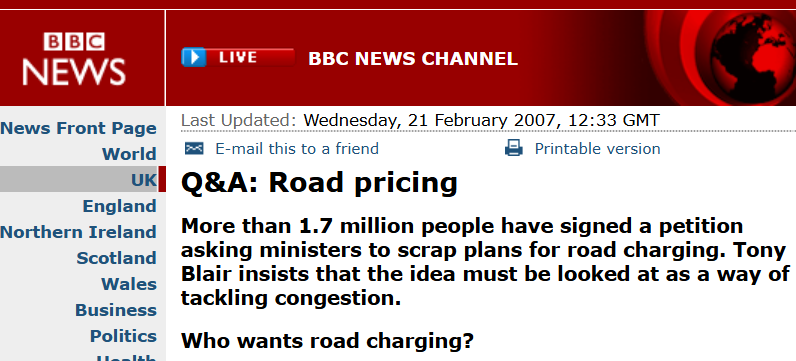
It’s not the first time they tried. In 2005-7 Tony Blair had a go at national road pricing. 1.7 million people signed a petition asking them to stop. So they stopped. They also tried to have local congestion charges in Manchester and Edinburgh. Those plans went to local referenda, and lost by 3:1. So they stopped those too.
London does have a congestion charge. It took them thirty years to implement. I once spoke with one of the architects of the original 1970s plan, and he said they all thought they were lucky to get away with not losing their jobs.
And if you go back to the beginning of the story, it didn’t happen in 1964, when a panel of top transport experts published the Smeed Report, saying that charging per mile would be the best way to lock in the benefits of all the new roads the country was building. Not only did that not happen, but the Prime Minister personally wrote on his briefing note ‘never again’. Smeed himself was sidelined from an expected promotion and left his road research lab. The lab lost its independence and was put under direct civil service control. Short of burning the building down, they couldn’t have been clearer.
But, for all that, the answer might be yes – yes a pay-per-mile plan might be about to work. And this is a paper I wrote last year saying why this time is different.
The Electric Window
This isn’t about the rights and wrongs of the policy.1 Just the underlying political contours.
It has proven near-impossible to impose a per-mile cost on all motorists. They push back – hard. But right now, you don’t have impose it on everyone.
At this point in time, something new is happening. The road fleet is splitting in two: petrol/diesel and electric. One pays tax; until recently the other paid none at all, and still pays no cost per mile.
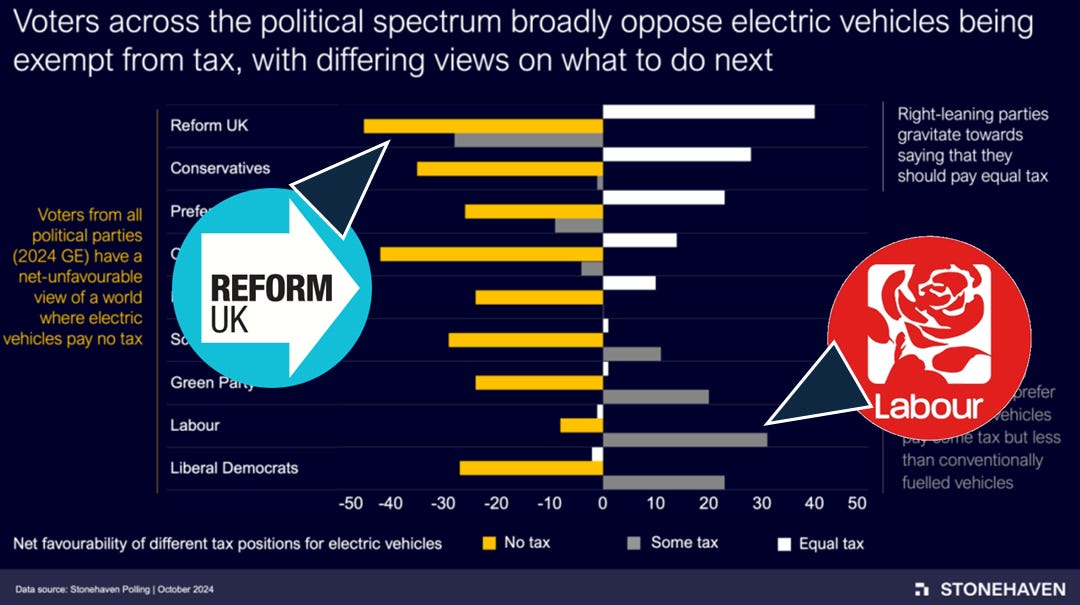
And, as we tested with some polls, that doesn’t carry the same public support. People will line up to stop 50p of fuel duty turning into 51p. But they feel differently if the starting number is 0p; and the new tax is paid by other people.
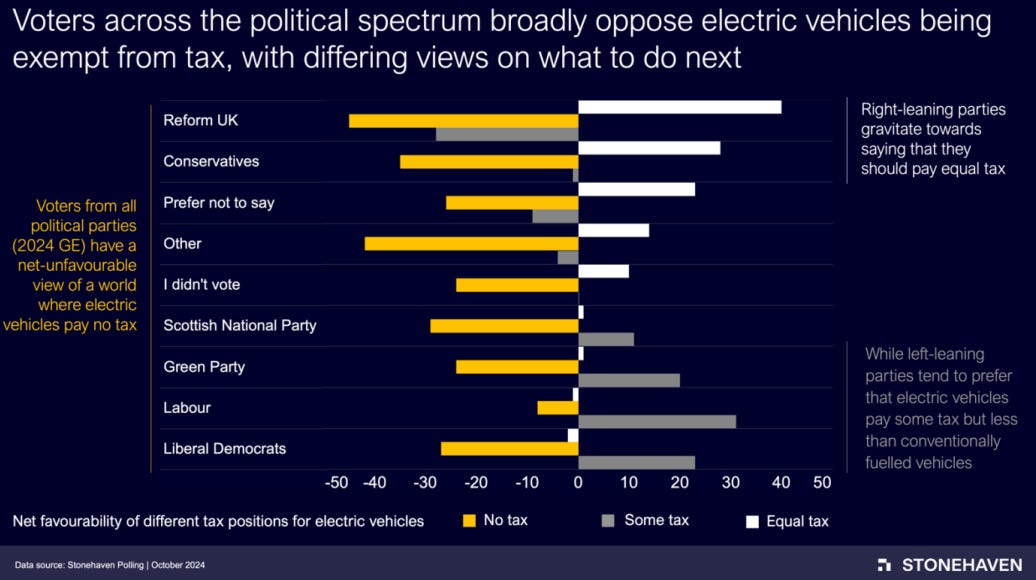
Motoring tax has been unshakeable when motorists hang together. But the rise of electric motoring means that, for a 10-15 year period, they probably won’t. And this is government’s opportunity to change the tax regime in a way they previously couldn’t.
I called this ‘the electric window’ – a time when the normal rules of motoring politics get suspended. It only lasts for as long as it takes for electric vehicle owners to become a large enough political force that once again they are once again too big to rouse.
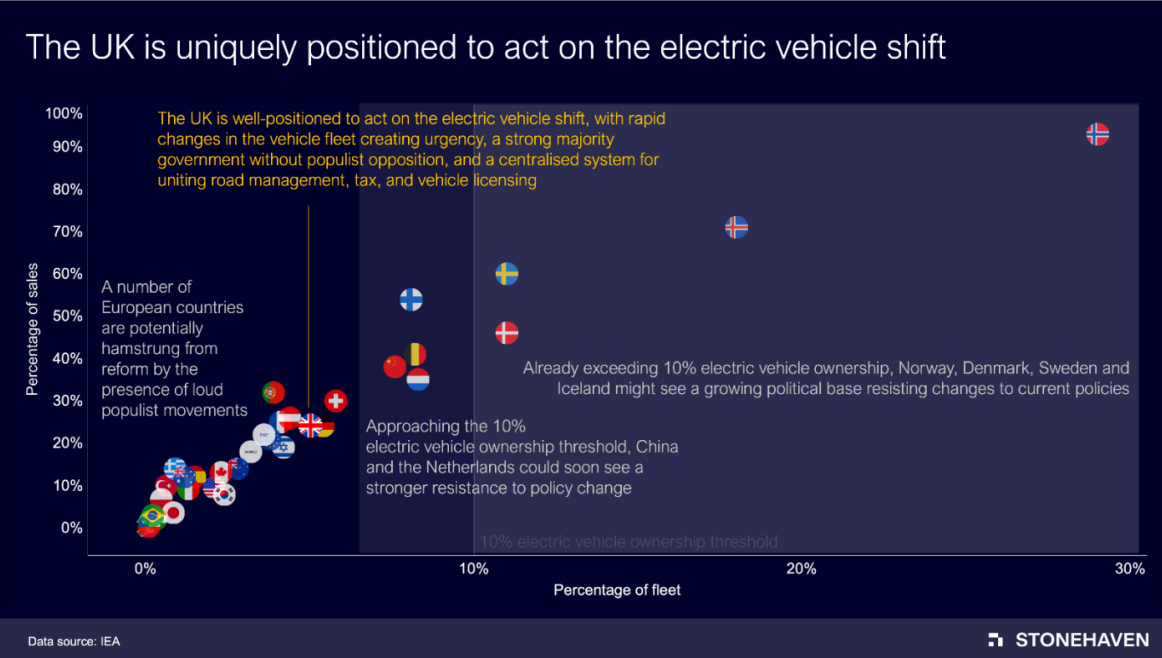
And there’s a particularly golden space within that window where there aren’t enough opponents to stop change and the people who lose out from change are so numerous that the cost of buying them off is trivial. If 5% of motorists are in electric cars, you can offer them big discounts without compromising the long-term tax revenue. Maybe even exempt them entirely. Why fuss about a few hundred million if you’re unlocking billions in long term revenue?2
It’s one thing to be told to pay a new tax. But it’s quite a different thing if you think everyone on the road is having to pay twice as much as you – because you were smart and got in early. If political opposition is your problem, this is the charmed time when you can just buy everyone off and write it off as the cost of doing business.
The real battleground
I don’t want to overstate the chances – this is a very bold ask. There are some points of detail that can absolutely wreck a new plan.
I’m particularly focused on the difference between charging at home (7-8p/KWh at best) and publicly (50-80p/KWh). That means a new per-mile charge is enough to make electric more expensive than petrol for some people.
But this is also fixable – and if government is about to nail its colours to a mast on a new tax, they have a big incentive to find answers.
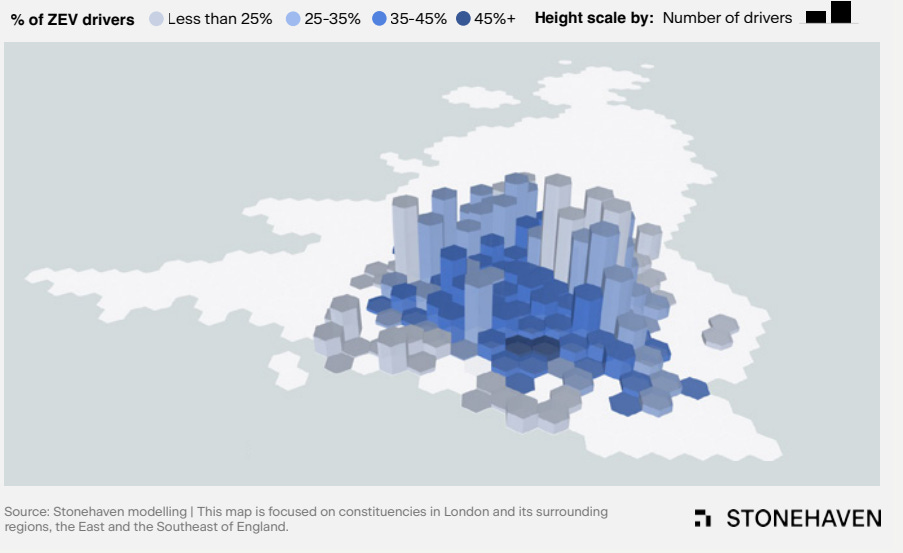
If you are a car company, you care about sales. And I reckon that about half the EV sales in the country are being prevented by solvable market problems. In East London, EV are hitting limits at about 5% takeup because of a lack of charging capacity.
And I also think that the people most exposed to change have a reason to pick their fights wisely. If you assume tax for EVs will come some day, whose government do you think they’d want to design it?
So for once, the impossible might just be possible…
Stay tuned for next week, when we’ll publish some numbers that throw more light on how.
Don’t think me unsympathetic - one of my career highlights was keeping EVs out of regular vehicle excise duty back in 2017. Which, now it’s all safely in the past, I can admit no one back at the Department had strictly asked me to...
…Said everyone shaking their head at every Budget cock-up ever